Managing the Project in the Era of High Velocity Engineering
There was a time—not too long ago, effectively capping around late 2022—when project management in software engineering was a largely predictable, linear science. Velocity was measured in story points, sprints lasted two weeks, and a good programmer was expected to write roughly 100 to 200 lines of solid, production-ready code per day. Managing the project meant using Jira or Trello to track these incremental changes, ensuring that QA had enough time to manually click through UI states before deployment.
But the game has changed completely. The physics of software development and, by extension, the entire discipline of software project management, have been fundamentally altered by the gravitational pull of autonomous generative artificial intelligence.
Today, according to recent benchmarks discussed vigorously on Hacker News and DEV.to, agentic coders are writing 1,000 lines of code per hour. When software is generated at this blistering pace, manually dragging Kanban cards and reading linear code diffs in GitHub PRs is no longer just inefficient—it is biologically impossible. Traditional 2D project management interfaces simply cannot contain the sheer volume, interconnectivity, and velocity of modern, AI-augmented software engineering.
This comprehensive 4,000-word analysis will explore the deep end of managing AI-driven software projects. We
will dissect the latest trends dominating Reddit's r/agile and r/coding
communities, unpack the viral concept of "Vibe Coding," examine the shift towards agentic scaffolding, and
finally, explain why visual, high-dimensional architecture like UpperSpace 5D is the only
sustainable way to manage the incoming flood of machine-generated business logic.
Part 1: The Four Generations of AI Project Integration
To understand how to manage the modern project, we must first understand what is injecting code into it. As noted by analysts at Builder.io and software architects across tech substacks, AI coding tools have rapidly progressed through four distinct generational paradigms within a startlingly compressed timeframe (2023-2025). This evolution has continuously broken legacy PM workflows.
- Generation 1: Localized Autocomplete (The Copilot Era). This was the birth of the modern AI assistant. Tools like the original GitHub Copilot lived inside the developer's IDE. They typed a comment, pushed Tab, and the AI generated a function. The project management didn't change; the developer simply completed subtasks 20% faster.
- Generation 2: Context-Aware Chat (The GPT-4 Era). Developers began pasting entire files or requirement documents into chat windows. They asked ChatGPT or Claude for optimizations or test scripts. The project manager now had to account for "AI hallucinations" disrupting sprint predictability, as developers blindly copy-pasted unverified logic.
- Generation 3: Agentic Execution (The Cursor/Windsurf Era). This is where project management broke in 2024. Tools like Cursor introduced Agent modes, while Windsurf introduced the "Cascade" autonomous agent. The AI could now read the workspace, coordinate changes across multiple files, and run basic terminal commands. When an agent changes 15 files across the frontend, backend, and database layer concurrently, the traditional concept of an "isolated ticket" or a "micro-commit" vanishes.
- Generation 4: Autonomous Structural Orchestration (The Current Paradigm). We are now entering an era where agents don't just write code; they design systems and execute Epics. They read high-level system specs, orchestrate architecture, and implement solutions across massive codebases autonomously. Managing these agents through a Jira board is like trying to monitor a global supply chain using sticky notes.
Part 2: The Viral Trend of "Vibe Coding" and PM Nightmares
If you have spent any time on developers' Twitter (X) or Hacker News over the last 18 months, you have inevitably encountered the term "Vibe Coding." Coined informally to describe the shift in how hyper-productive developers interact with their machines, vibe coding represents a radical departure from traditional computer science methodology—and a massive headache for traditional Product Managers.
What is Vibe Coding? TRENDING
Vibe coding is the practice of building software primarily through high-level, natural language intent rather than strict algorithmic syntax. Instead of a PM writing a deeply technical, 15-page PRD, a "vibe coder" takes a loose directive (a "vibe") and prompts the AI agent: "We need to migrate our auth to OAuth2. Keep it feeling exactly like the old login flow. Handle all the edge cases with AWS Cognito. Build it."
The developer acts as an Art Director for software, guiding the constraints of the application while delegating the tedious syntactical execution to tools like Claude 3.5 or OpenAI's latest models.
Why "Vibe Coding" Breaks Agile and Scrum
While vibe coding is incredibly fast—allowing solo technical founders to deploy complex, scalable architectures in a weekend—it introduces a critical enterprise vulnerability: Architectural Blindness.
When you vibe code, the AI generates the scaffolding, the database schema, the API routes, and the frontend state management simultaneously. The human developer rarely reads every associated line of code. They trust the "vibe" and the immediate observable output.
For a Project Manager, this is terrifying. How do you estimate points? How do you perform QA on a system that was built in four minutes but contains 10,000 lines of complex AWS integrations? When a bug inevitably occurs under load, the developer is forced to debug a system they technically commanded to exist, but never explicitly designed or read. This leads to the infamous "Breaks Off" coding phenomenon—the moment the AI scaffolding inevitably fractures, and the human is too disconnected from the architecture to repair it quickly, completely shattering the sprint timeline.
"Vibe coding is the fastest way to build an MVP, and the absolute fastest way to create an unmaintainable legacy nightmare. If the Product Manager and the Lead Engineer don't have a macro-architectural view of what the AI just built, you aren't managing a software project; you're just gambling on machine output." — Dev.to Management Leadership Consensus, 2025.
Part 3: 2025 Tricks for Managing High Velocity Generation
To survive the velocity of Generation 3 and 4 AI tools without succumbing to architectural blindness, top-tier engineering managers have developed specific project management workflows and tricks. These are the strategies currently dominating deep technical leadership discussions.
Trick 1: Product Specs to spec.md Anchor Protocol
The most important trick for managing autonomous platforms like Cursor, Windsurf, or Spec-Kit is bridging the gap between the Product Manager's intent and the AI's execution space. Legacy PMs wrote PRDs in Google Docs. High-velocity PMs write Machine-Readable Specifications.
- Before a single automated prompt is fired, the PM and Tech Lead co-create a highly detailed
spec.mdfile residing in the codebase repository—not a separate Jira board. - This markdown file serves as the ultimate source of truth. It defines the exact data schemas, API routes, component tree architecture, business logic flows, and explicitly forbids certain libraries or patterns (e.g., "Do NOT introduce new styling libraries; use the existing internal design system tokens.")
- When a developer tasks an agentic AI to build a feature, they anchor the prompt: "Implement the user
dashboard widget strictly according to the architecture and constraints defined in
/docs/project-alpha-spec.md."
This enforces strict architectural governance on "vibe coding," ensuring the LLM operates inside rigid, human-defined, project-managed constraints.
Trick 2: Orchestration Over Delegation (Multi-Agent Workflows)
Managing an AI-driven project means recognizing that different AI models excel at different phases of the software lifecycle. High-velocity project managers actively orchestrate multi-agent workflows.
A PM might use a highly creative, reasoning-focused model (like Claude 3.5 Sonnet) to rapidly ideate and draft the initial system architecture and schema design. The team then imports those designs into the actual repository. Finally, they unleash a heavy, structurally-aware coding agent (like Spec-Kit) via an MCP (Model Context Protocol) to rigidly generate the boilerplate, write the backend tests, and wire the global networking together according to the exact constraints of the plan. Project management shifts from assigning tasks to specific human developers to routing technical specifications through the optimal succession of AI agents.
Part 4: A Higher Dimension of Project Architecture (UpperSpace 5D)
While the tricks mentioned above (machine-readable specs, anchoring protocols, multi-agent routing) help manage the flow of AI-generated project work, they still fundamentally rely on humans trying to review logic changes by reading 2D pull requests on GitHub. When your agents are generating 1,000 lines an hour across 40 files, a 2D text-based PR review process is a massive, project-killing bottleneck.
You need a higher dimension architecture to manage the project itself. You need a system that translates the overwhelming flood of code commits into an instantly readable, macro-level structural visualization.
UpperSpace 5D is the definitive solution to the modern project scaling problem.
Visualizing Project Velocity UPPERSPACE
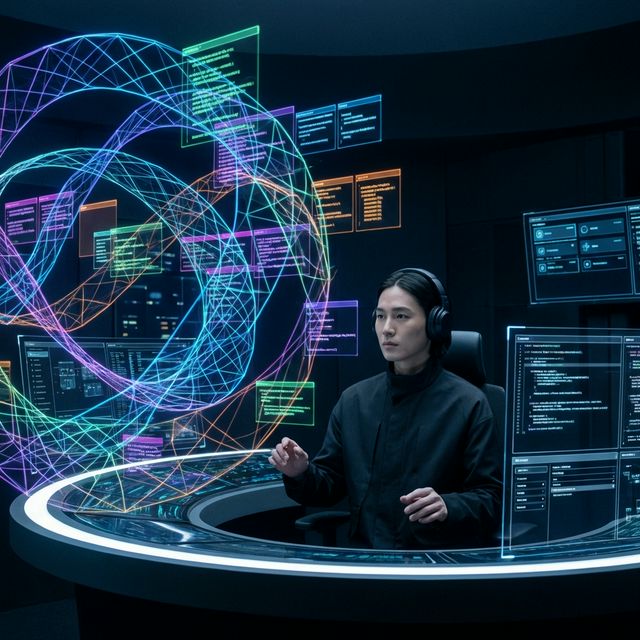
The standard Git file tree was invented decades ago to track changes in linear text documents. UpperSpace 5D abandons the flat file tree. It reads your codebase continuously and builds a High-Definition Topology—a living, dynamic map of your software architecture.
The Spatial Organization of Logic
Instead of staring at Jira boards to understand project progress, UpperSpace 5D allows managers and lead engineers to view the actual architecture in the browser like a high-dimension, evolving organism.
When an AI agent (or a human developer) commits a new authentication service, the Tech Lead does not review
it by opening eight different .ts files in a GitHub PR. They look at the UpperSpace topology.
They watch, visually, as the AI agent connects the new "Auth Node" to the "Database Cluster." They visually
verify that the structural dependencies are sound, identifying architectural anti-patterns instantly before
the code is merged.
Stepping Inside the Project: 3D Virtual Reality
For ultimate project oversight, UpperSpace 5D transcends the 2D screen. Utilizing WebXR and advanced spatial computing frameworks, stakeholders can simulate and manipulate the codebase architecture in 3D virtual reality.
Using platforms like Meta's Horizon World or Apple VisionOS, technical project managers can physically engage with the software's structure.
- Structural Weight and Tech Debt: Heavily coupled code visibly appears as dense, tangled structures, instantly highlighting technical debt hotspots that an AI agent might have accidentally created during a high-speed sprint.
- Data Flow Verification: Instead of writing complex integration tests to verify a new feature, PMs and QA can watch simulated data payloads physically trace through the 3D topology, lighting up the exact services and nodes it touches to verify business logic routes.
- Spatial Sprint Planning: Product leaders can spatially highlight a section of the codebase and designate it for an upcoming sprint, visually identifying every dependent node that must be updated.
Part 5: The End Objective - Pure Human/AI Synchronicity
The ultimate goal of project management in 2026 is no longer about managing human burn-out or tracking story point velocity. It is about establishing perfect synchronicity between human intent, architectural integrity, and machine execution speed.
The 5-dimensional architecture provided by UpperSpace is the only tool that solves the core problem of AI-augmented project management: Context Asymmetry.
When a human Product Manager writes a ticket, they are thinking in abstract user flows. When an LLM executes the code, it acts on probabilistic vector associations. To manage this divide, both the human orchestrator and the AI agent must share the same mental model.
By shifting the project management interface to a high-definition topology—a spatial, visual representation of the codebase's structural truth—you and your AI execution agents are finally on the exact same page. The human understands the project intrinsically and spatially.
When the AI agent accomplishes a massive structural sprint task, you don't read 5,000 lines of diffs. You watch the 5D structure morph to match the system spec. You understand the "vibe" of the generated software not through blind trust, but through immediate, visceral, spatial verification of the architecture.
The New Paradigm for Project Orchestrators
The era of the text-editor bound programmer and the Kanban-bound project manager is ending simultaneously. The sheer velocity of machine-generated code will continue to increase exponentially. Those who cling to manual PR reviews, flat file trees, and 2D task tracking will inevitably lose visibility, leading to catastrophic technical debt and project failure.
To survive and thrive, engineering leadership must elevate its perspective. By writing machine-readable specifications, mastering multi-agent orchestration workflows, and most importantly, utilizing spatial, high-dimensional topologies like UpperSpace 5D, project management transforms into true architectural orchestration. It is the new age discipline for a new age of development. Welcome to sustainable, controlled High Velocity Engineering.