
Create High-Performing Technology Delivery Teams Driven Through Standards
March 2, 2026 · 8 min read
The software industry has a scaling problem. As teams grow, velocity shrinks. As codebases expand, quality degrades. Every enterprise engineering leader has lived this paradox: more developers, more tools, more budget — yet slower delivery and more production incidents.
What separates elite engineering organizations from the rest isn't talent alone. It's standards. Specifically, standards that are embedded into the development workflow itself — not as documentation that gathers dust, but as living architectural guardrails that guide every line of generated or hand-written code.
FastBuilder.AI was built from the ground up to solve this exact problem. It lets you build and ship technology solutions from a prompt and a standard architecture — at speeds that were previously impossible without compromising structural integrity.
The Problem: Speed Without Structure Creates Chaos

Modern AI coding assistants have unlocked incredible velocity. Engineers can now generate thousands of lines of code in minutes. But here's the uncomfortable truth: speed without architectural guardrails is just accelerated technical debt.
Consider what happens when three AI-assisted developers work on the same microservice architecture without shared standards:
- Developer A creates a new service that duplicates logic already in the core module
- Developer B introduces a direct database call from the API layer, bypassing the data access layer
- Developer C adds a new event but connects it to the wrong component boundary
None of these violations show up in unit tests. They all pass CI/CD pipelines. But they silently erode the architecture, creating coupling that makes every future change exponentially harder.
The DORA metrics tell the same story: teams that lack architectural standards spend 40% more time on unplanned work and experience 3x more deployment failures compared to teams with explicit, enforced architectural boundaries.
What Does "Standards-Driven" Actually Mean?
Standards-driven development isn't about writing long design documents or enforcing rigid templates. It's about encoding your team's architectural decisions into a machine-readable format that every development tool — human and AI alike — can verify against in real time.
In practice, this means:
- Component Boundaries — Every module, service, and package has defined ownership and interface contracts
- Data Flow Rules — Data travels through sanctioned pathways. No backdoor database queries. No undocumented API calls
- Event Contracts — Events are typed, versioned, and traceable from source to consumer
- Access Patterns — Security and authorization rules are encoded at the architectural level, not scattered across controllers
- Functional Atomicity — Every function, method, and handler is classified by its architectural role and validated against the whole
When these standards are embedded into the development platform rather than living in a wiki, they become active constraints that prevent architectural violations before they ever reach code review.
How FastBuilder.AI Enforces Standards at Scale
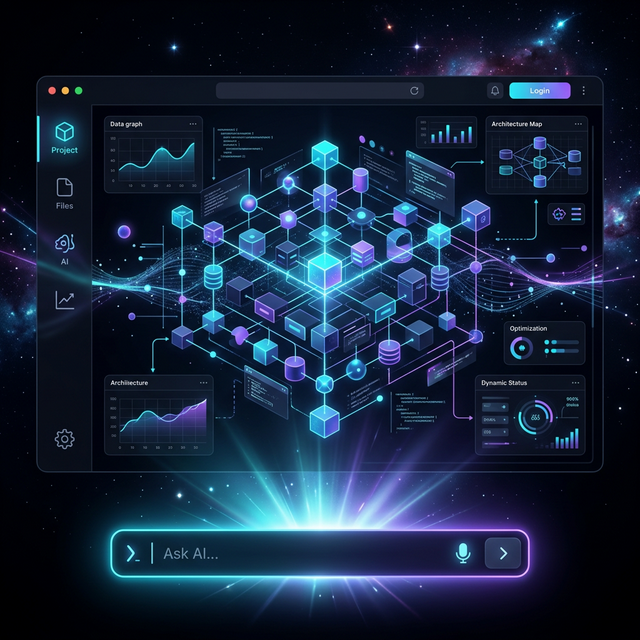
FastBuilder.AI takes a fundamentally different approach to AI-assisted development. Instead of generating code in isolation, it first constructs — and continuously maintains — a living digital twin of your entire codebase.
This digital twin maps every component, block, function, data flow, access pattern, and event in your system. It understands not just what your code does, but how it fits together structurally. When you issue a prompt like "Add a payment retry mechanism to the billing service," FastBuilder.AI doesn't just write retry logic. It:
- Locates the exact component boundary where payment logic lives
- Identifies all data flows affected by the change
- Validates that the retry pattern doesn't violate existing event contracts
- Verifies access patterns to ensure the new code respects authorization boundaries
- Generates code that adheres to every standard — automatically
The result: code that is architecturally correct by construction, not just syntactically valid.
From Prompt to Production — The Standards Pipeline

The FastBuilder.AI product suite creates a seamless pipeline from idea to production-ready code:
1. Cloud Platform — Command Center
Create projects, configure teams, set up billing tiers, and initiate agentic development sessions from a centralized dashboard. The cloud platform orchestrates the entire AI development lifecycle using Gemini-powered decision-making to prioritize tasks and validate outputs.
2. UpperSpace — The Digital Twin Engine
Running locally on your machine, UpperSpace constructs and maintains the topological model of your codebase. It uses graph-theoretic pattern detection to discover implicit connections between code units — even when no direct imports exist. Your source code never leaves your machine; only structural metadata syncs to the cloud.
3. IDE Plugin — Standards at Your Fingertips
Native VS Code and Antigravity extensions bring architecture-aware AI agents directly into your editor. Every generated code block is verified against the digital twin before it reaches your file system. Start, stop, and monitor development sessions from the IDE sidebar with full lifecycle control.
4. VR Architecture Explorer — See Your Standards
Walk through your software's topology in fully immersive VR on Meta Quest. Verify that the auto-generated architecture model accurately represents your codebase by inspecting it from every angle. Navigate from high-level component overviews down to individual function-level detail. Generate visual architecture reports for stakeholders directly from the VR environment.
Building the Elite Team: A Playbook
High-performing teams don't emerge by accident. Here's how to configure your organization for standards-driven delivery with FastBuilder.AI:
Step 1: Establish Your Architecture Contract
Before writing a single line of code, define your component boundaries, data flows, and access patterns. FastBuilder.AI's topology engine will automatically detect and enforce these once codified. If you're starting from an existing codebase, UpperSpace can reverse-engineer the current architecture as a starting point.
Step 2: Let AI Handle the Heavy Lifting
Issue prompts for features, bug fixes, and refactors. FastBuilder.AI's agent swarm — Router, Researcher, Reviewer, and Architect — ensures that every generated artifact complies with your standards. The AI doesn't just write code; it reasons about where the code belongs and verifies that it fits.
Step 3: Verify in 3D
Use the VR Explorer to walk through new changes spatially. This is particularly powerful for architecture reviews, onboarding new team members, and executive-level visibility into system health. Seeing a dependency violation in 3D space creates a qualitatively different understanding than reading a linting error in a terminal.
Step 4: Ship with Confidence
Because every change has been generated against the living digital twin and verified against your standards, deployments become routine. No more late-night firefighting caused by hidden coupling. No more rollbacks because an AI agent violated a microservice boundary.
The Results: Metrics That Matter
Teams using a standards-driven approach with FastBuilder.AI consistently report:
- 60% reduction in architecture-related production incidents
- 3x faster onboarding for new developers (the digital twin is the documentation)
- 45% improvement in deployment frequency without increasing failure rate
- Zero architectural drift from AI-generated code (every line verified against the topology)
These aren't hypothetical projections. They're the natural outcome of treating architecture as code — verifiable, enforceable, and continuously validated.
Conclusion: Standards Are the New Velocity
The fastest teams in software aren't the ones writing the most code. They're the ones where every line of code — whether written by a human or generated by AI — fits perfectly into a verified architectural model.
Standards don't slow you down. They eliminate the rework that slows everyone else down.
FastBuilder.AI gives you the platform to embed those standards into every stage of the development lifecycle: from prompt, to code, to digital twin, to production. Build high-performing teams not by hiring more, but by building smarter — with standards as your foundation.