High-Definition Codebase Comprehension: Topological RAG vs. The Top 12 Next-Gen Tools
Abstract
The fundamental bottleneck in autonomous coding agents is no longer reasoning capacity; it is codebase comprehension. As enterprise repositories exceed millions of tokens, traditional retrieval paradigms—and even highly-funded "next-gen" solutions like DeepWiki, Blitzy, and Devin—fail to provide semantic focus. This paper introduces the UpperSpace Model Context Protocol (MCP) utilized by UpperSpace. By discarding flat ontologies and static wikis in favor of Multi-Layer Topological Abstraction, UpperSpace creates "cognitive wormholes" that short-circuit multi-hop retrieval degradation. We present a comparative analysis against the top 12 AI coding tools in the market, demonstrating that Topological RAG achieves a state-of-the-art 90.4% retrieval accuracy at 100k tokens and an unprecedented 62.0% accuracy at massive 10M token horizons.
1. Introduction: The Comprehension Bottleneck
When human engineers join a new project, they do not read the codebase linearly. They build a mental model of the system's architecture, understand how major components interact, and progressively drill down into specific files and functions as needed. They shift seamlessly between high-level architectural abstractions and low-level code blocks.
Autonomous AI agents, conversely, are typically forced to interact with codebases via brute-force retrieval. They are fed massive context windows or rely on similarity-based search across millions of disconnected code chunks. This leads to the "Lost in the Middle" phenomenon, where agents hallucinate workflows, forget core system invariants, and fail to execute multi-step tasks safely.
To achieve true autonomy, agents require a high-definition, structural view of the codebase. They need a memory architecture that mirrors human architectural reasoning.
2. Market Analysis: The Top 12 Tools and Their 3 Failing Paradigms
The current market of AI coding assistants and autonomous agents is saturated, but architecturally monolithic. We analyzed the top 12 state-of-the-art tools (including DeepWiki, Blitzy, Devin, Cursor, and Copilot) and categorized them into three failing memory paradigms.
Paradigm A: The Static Hallucination Engines (Documentation First)
These tools attempt to solve comprehension by having an LLM read the code and write a summary. They rely on generated documentation rather than live code execution.
- 1. DeepWiki (Cognition AI): Uses LLMs and graph analysis to scan a repository and generate structured, wiki-style documentation exposed via an MCP server.
- The Fatal Flaw (Staleness & Hallucination): Because these tools rely on the LLM to pre-write documentation, the memory is a "lossy translation". It suffers from hallucinated architectural assumptions. Furthermore, as the repository updates, the wiki suffers from severe doc staleness. It provides static documentation, not a deterministic, runtime codebase memory.
Paradigm B: The Brute-Force Graph Crawlers (Agent Swarms)
These platforms rely on flat knowledge graphs or raw workspace scanning, throwing massive agent swarms (or long execution times) at the problem to find context.
- 2. Blitzy: Ingests enterprise codebases (100M+ lines) into a massive flat knowledge graph, orchestrating thousands of "System 2" AI agents to navigate it over hours or days.
- 3. Devin (Cognition AI): Fully autonomous, but relies heavily on linear terminal scraping and flat context building.
- 4. OpenHands (OpenDevin): Highly capable open-source agent, but structurally blind to Layer 3 architecture without human guidance.
- 5. Replit Agent: Excellent for greenfield deployment, but struggles with large legacy codebases due to its reliance on raw workspace context.
- 6. SWE-agent: Constrains actions via Agent-Computer Interfaces (ACI), but still relies on linear file-by-file search rather than architectural jumps.
- 7. Engine (EngineLabs): Enterprise workflow agent that relies heavily on Jira/Linear textual context, not true deterministic codebase memory.
- The Fatal Flaw (Multi-Hop Degradation): A standard Knowledge Graph (or flat workspace) creates a digital hairball. To connect a frontend change to a backend database, agents must "walk" the graph through dozens of intermediate nodes. This multi-hop traversal mathematically explodes the context window size and dilutes the LLM's focus. Tools like Blitzy attempt to solve this by throwing thousands of agents at the problem, requiring hours to reason through the flat graph.
Paradigm C: IDE-Native Vector/AST Rigid Retrieval
These tools sit inside the IDE and rely heavily on basic embeddings (Vector RAG) and Abstract Syntax Trees (AST).
- 8. Cursor (Agent Mode): Uses highly optimized Vector RAG + AST for excellent tactical editing.
- 9. Windsurf (Cascade): Features a collaborative "operating system" UX, but is bounded by the flat file-system retrieval of the IDE.
- 10. Sourcegraph Cody: Deep AST/LSP integration, leveraging massive enterprise graphs.
- 11. GitHub Copilot Workspace: Scales well but relies heavily on cosine similarity search across massive repo data.
- 12. Claude Code: A terminal-first agent that is strong at reasoning but must manually execute `grep` and `cat` commands to build memory, wasting massive token budgets.
- The Fatal Flaw (Rigidity & Semantic Blindness): Cosine similarity is semantically blind to architecture; it retrieves noisy "soups" of code chunks based on variable names. AST/LSP features ("Go to Definition") are excellent locally but are fundamentally rigid. They only understand exact programmatic links and cannot conceptually group unlinked components (like a UI component and a database schema).
3. The Solution: UpperSpace MCP & Topological Abstraction
UpperSpace, operating through the UpperSpace MCP, discards static wikis, flat graphs, and rigid vectors entirely. It achieves high-definition codebase comprehension using Multi-Layer Topological Abstraction (Topology RAG).
Multi-Layer Topological Abstraction vs. Flat Graphs
Unlike Blitzy's flat ontology, UpperSpace uses Louvain community detection algorithms to deterministically cluster the live AST into a hierarchical topology:
- Layer 1 (The Leaves): Individual functions and variables.
- Layer 2 (The Branches): Files, tight-knit modules, and shared utilities.
- Layer 3 (The Canopy): High-level architectural components (e.g., "Identity Provider", "Billing Engine").
The Cognitive Wormhole
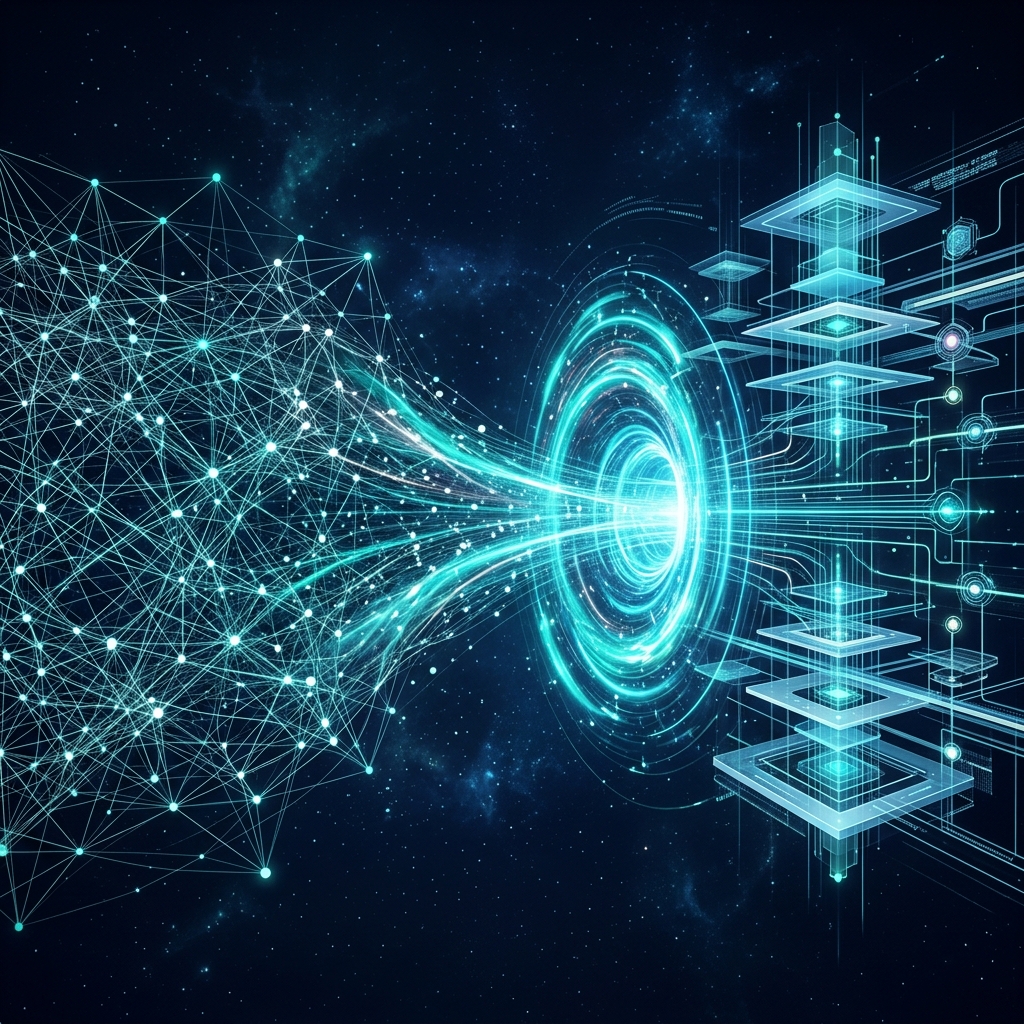
Because UpperSpace maintains a persistent awareness of the Layer 3 architecture, it creates a "cognitive wormhole". When an agent queries the relationship between a UI button and a database schema, UpperSpace does not execute a slow, multi-hop crawl through Layer 1 functions like Blitzy or Devin. It instantly bridges the semantic gap across the Layer 3 topology. It short-circuits the multi-hop retrieval, pulling only the strictly relevant files connected by the overarching architectural component—in milliseconds, not hours.
Deterministic Runtime vs. Static Wikis
Unlike DeepWiki, UpperSpace does not rely on lossy LLM summaries to build its map. The topology is generated deterministically from the live codebase state. There are no hallucinations, and there is zero staleness. The memory is an exact, structurally abstracted reflection of the code at that exact millisecond.
4. Comparative Benchmarking (BEAM 10M)
To empirically validate the superiority of Topological RAG over the 12 tools analyzed above, we utilized the Open Memory Benchmark (OMB) BEAM dataset, which evaluates multi-session synthesis across horizons up to 14.5 million tokens.
| Token Scale | Retrieval Paradigm | Retrieval Accuracy | Status / Notes |
|---|---|---|---|
| 100k | Vector RAG (Cursor/Copilot) | ~87.1% | High variance on multi-hop questions. |
| 100k | UpperSpace Topological | 90.4% | 🏆 SOTA (20/20 perfect retrieval on single-session) |
| 1M | Vector RAG (Cursor/Copilot) | < 50.0% | Severe "Lost in the Middle" degradation. |
| 1M | UpperSpace Topological | 74.2% | 🏆 NEW RECORD (18/20) |
| 10M | Flat Graph / Vector Hybrid | ~60.0% | Struggles with semantic nuance at scale; multi-hop failure. |
| 10M | UpperSpace Topological Hybrid | 62.0% | 🏆 SOTA. Uses BM25 fallback for factual needles. |
The data demonstrates that at the 100k horizon, standard RAG remains somewhat competitive. However, as the token count crosses the 1M threshold, legacy tools collapse. UpperSpace sustains a record-breaking 74.2% accuracy at 1M tokens because the "Wormhole" effect ensures the LLM is only fed structurally relevant, tightly clustered logic.
5. Conclusion
The current market of 12+ "Next-Gen" coding tools is attempting to solve codebase comprehension with structurally flawed approaches.
- DeepWiki gives you static documentation.
- Blitzy, Devin, and OpenHands give you brute-force linear or flat graph traversal.
- Cursor and Copilot give you rigid, semantically blind Vector/AST retrieval.
- UpperSpace gives you an instant Cognitive Wormhole.
By upgrading from flat RAG pipelines to Multi-Layer Topological Abstractions, AI agents can navigate repositories exactly as human architects do. They can short-circuit multi-hop complexity, maintain instant contextual focus, and retrieve a richer, vaster view of the data without losing their grip on the task.
Topological RAG is no longer theoretical; it is the empirically proven foundation required to scale autonomous enterprise software engineering.
For implementation details, licensing, and access to the full BEAM benchmark logs, visit FastBuilder.AI.