The Four Paradigms of RAG - A Technical Comparison
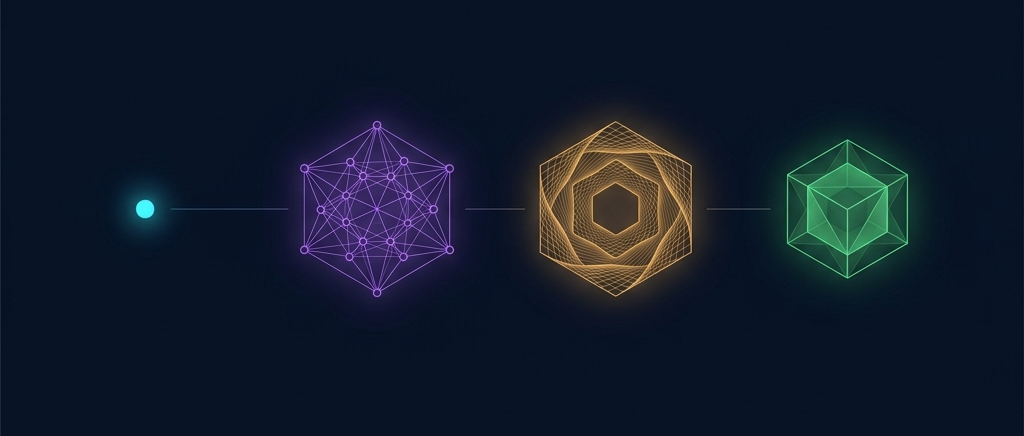
Every RAG system answers the same fundamental question: given a user query, how do you find the right context to feed an LLM?
The answer depends entirely on how you represent and index your knowledge. The four paradigms below represent four fundamentally different answers — each with distinct strengths, failure modes, and ideal use cases.
Vector Vector RAG
Embeddings + Chunking + Top-K
How It Works
The classic approach. The one everyone starts with.
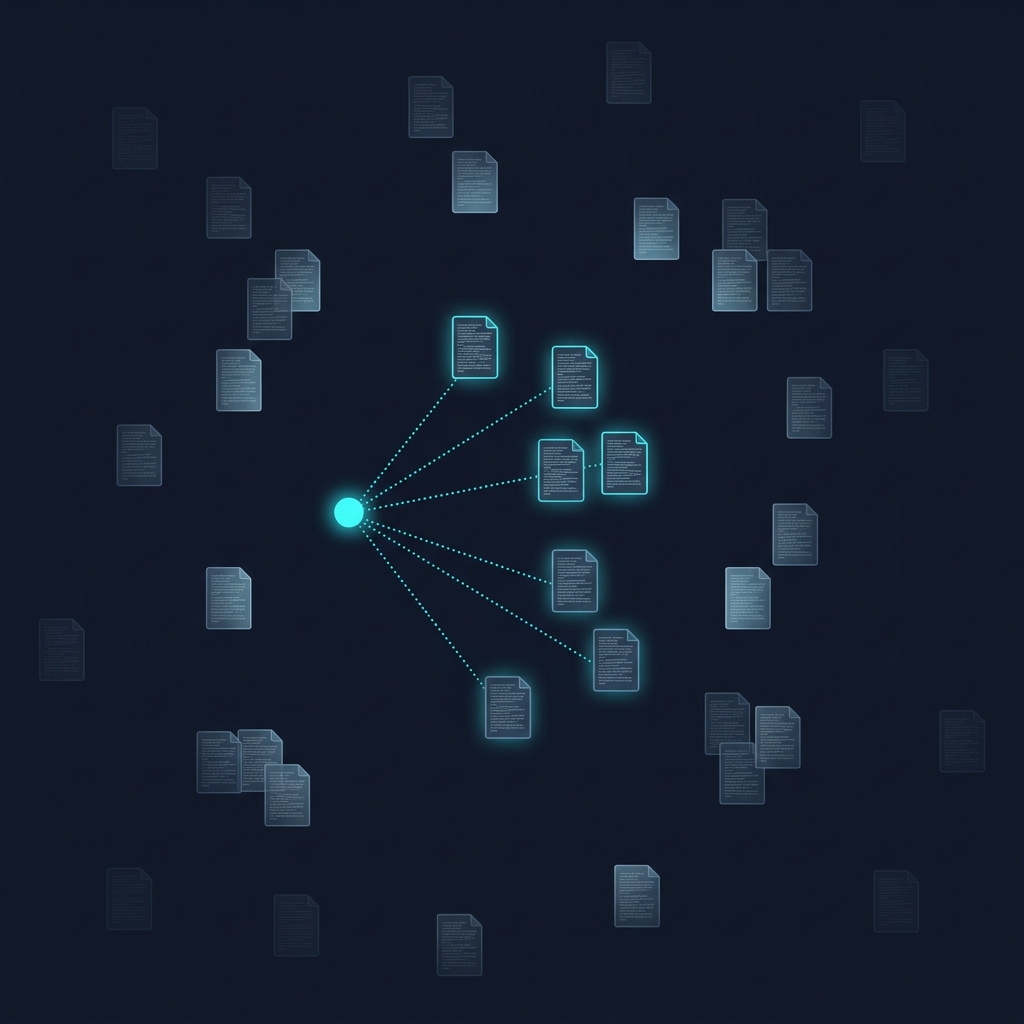
- Chunk your documents into fixed-size or semantically coherent fragments (512 tokens, paragraph boundaries, sliding windows)
- Embed each chunk into a dense vector using an embedding model (OpenAI
text-embedding-3-large, Cohere, BGE, etc.) - Index the vectors in a vector store (Pinecone, Weaviate, Qdrant, Chroma, FAISS, etc.)
- Query by embedding the user's question and retrieving the top-K nearest vectors by cosine similarity or dot product
- Stuff the retrieved chunks into the LLM prompt as context
Strengths
- Simple and well-understood — the most tooling, most tutorials, most production deployments
- Works out of the box — embed, index, query. No graph modeling, no ontology design
- Scales horizontally — vector databases are designed for billions of vectors
- Language-agnostic — the embedding model handles semantic similarity across languages
Failure Modes
| Failure | Why It Happens |
|---|---|
| Lost relationships | Chunking destroys cross-document relationships. If fact A is in chunk 17 and its causal relationship to fact B is in chunk 342, top-K retrieval won't link them. |
| Semantic drift | The query "How does authentication work?" might retrieve 5 chunks that each mention "auth" but from 5 different contexts — login, API keys, OAuth, JWT, certificate pinning — without any structural coherence. |
| Needle in a haystack | Rare but critical facts get buried. If the correct answer appears in one chunk among 100,000, cosine similarity may rank it below more "semantically popular" but less accurate chunks. |
| No reasoning path | You get similar content, not connected content. There's no traversal, no inference chain, no causal path from query to answer. |
| Chunk boundary artifacts | A critical sentence split across two chunks may never surface because neither half is semantically complete on its own. |
Best For
- FAQ-style retrieval, documentation search, simple Q&A
- Use cases where documents are self-contained and relationships don't matter
- Rapid prototyping and MVPs
Graph Graph RAG
Microsoft GraphRAG and Similar
How It Works
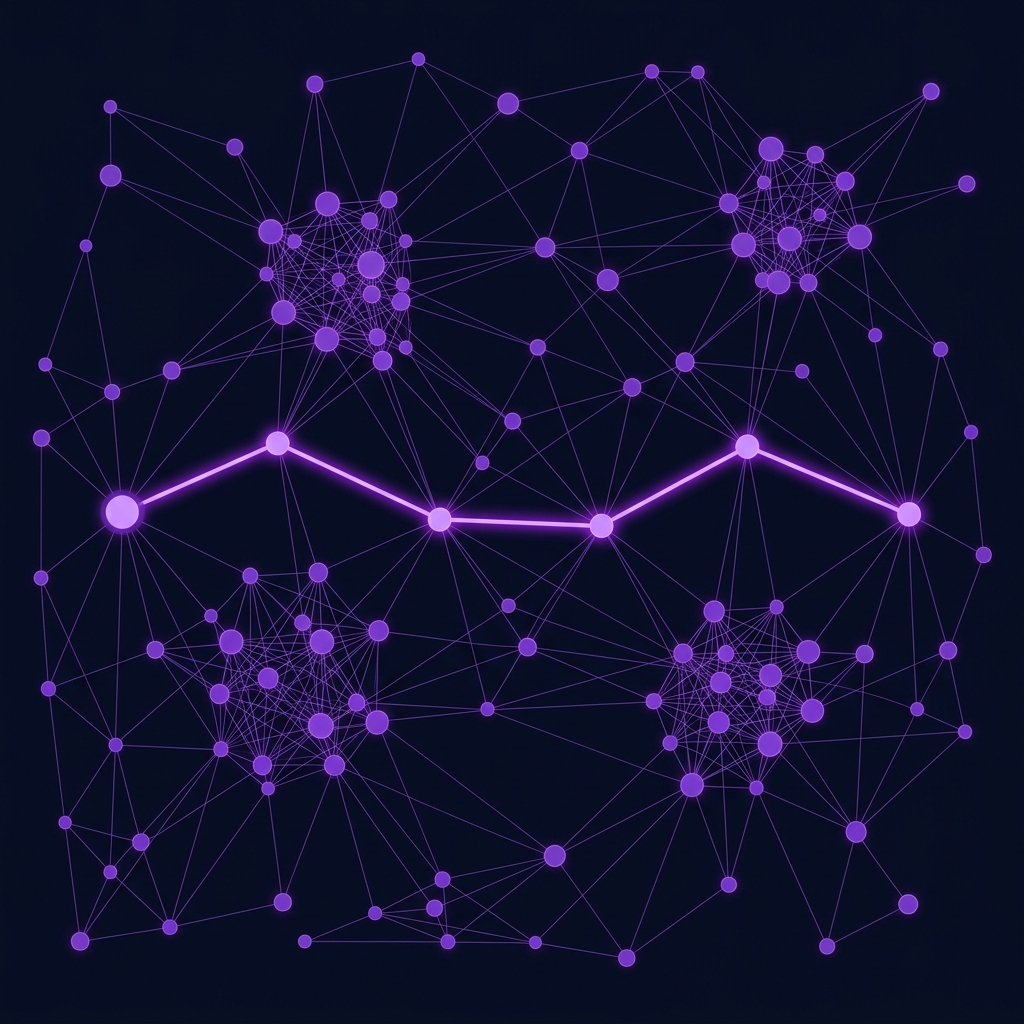
Microsoft GraphRAG introduced a fundamentally different approach: instead of indexing chunks, build a knowledge graph from the corpus first, then query the graph.
- Extract entities and relationships from documents using an LLM — people, organizations, events, concepts, and how they connect
- Build a knowledge graph with entities as nodes and relationships as edges
- Detect communities in the graph using algorithms like Leiden clustering — groups of densely connected entities
- Generate community summaries — LLM-produced summaries of what each community represents
- Query using two modes:
- Local search: Start from entities relevant to the query, traverse their neighborhood
- Global search: Use community summaries for broad, thematic questions
Strengths
- Captures relationships — "Person A works at Company B which is involved in Event C" is preserved as a traversable path
- Supports multi-hop reasoning — queries like "What are the downstream effects of X?" can follow causal chains
- Community-level understanding — global search can answer questions about themes and patterns across the entire corpus
- Handles cross-document relationships — facts scattered across many documents are unified into a single graph
Failure Modes
| Failure | Why It Happens |
|---|---|
| LLM extraction quality | The graph is only as good as the entity/relationship extraction. LLMs hallucinate entities, miss implicit relationships, and struggle with domain-specific content. |
| Expensive to build | Building the graph requires processing every document through an LLM. For a 100K-document corpus, this can cost thousands of dollars and take hours/days. |
| Static graph | The graph is a snapshot. When documents change, the entire extraction pipeline must re-run. No reliable incremental updates. |
| Entity resolution | "Microsoft", "MSFT", "the Redmond company" — all the same entity. Graph RAG must resolve these and frequently doesn't. |
| Overgeneralization | Community summaries smooth over important nuances. The summary might say "these companies are involved in AI" when the actual relationships are far more specific. |
| No data-level structure | The graph captures what entities exist and how they relate, but not schemas, access patterns, or event flows. |
Best For
- Investigative research across large document corpora
- Questions that require multi-hop reasoning: "How is X connected to Y?"
- Thematic analysis: "What are the major trends across these 10,000 reports?"
Topology Topology RAG
FastMemory / Topology-Based Retrieval
How It Works
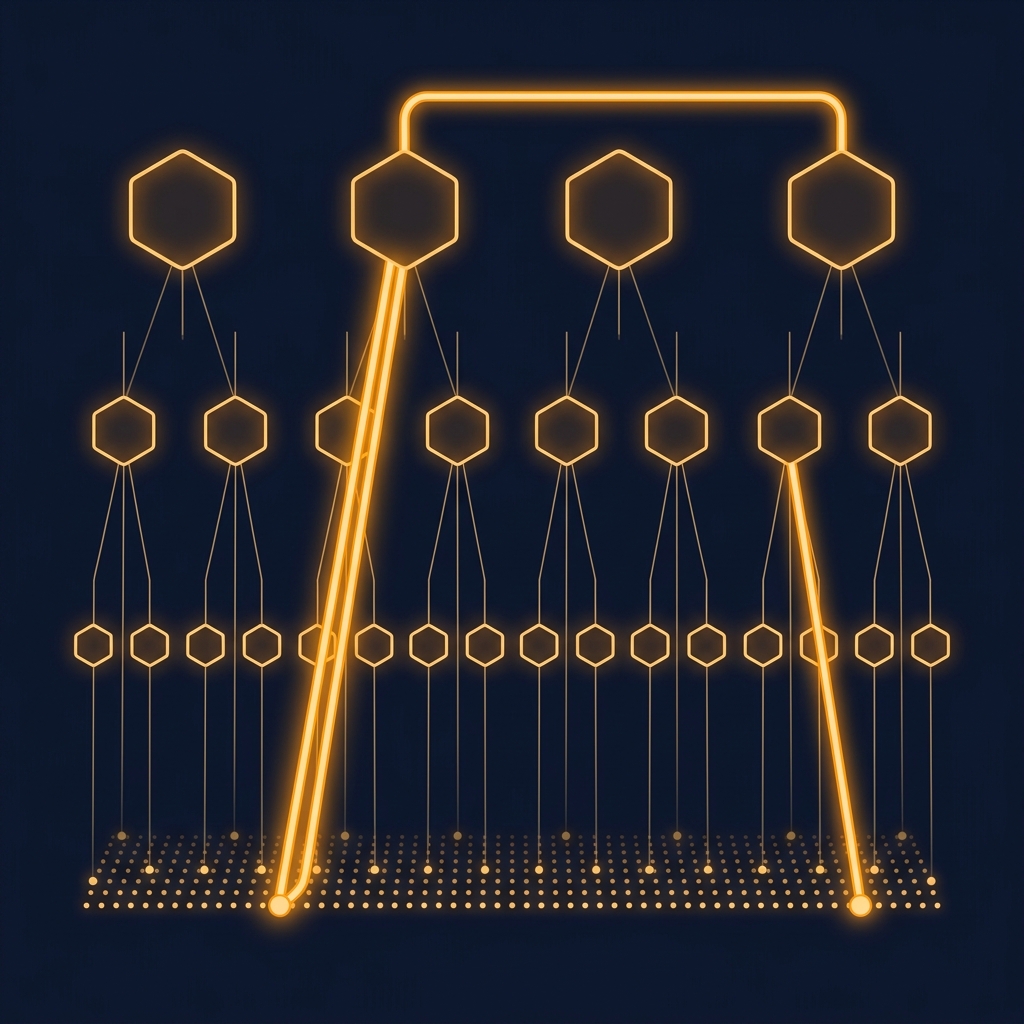
FastMemory takes a third approach: instead of embedding chunks or extracting entity graphs, it builds a topology — a structured, multi-dimensional architectural map of the knowledge space.
- Ingest data through actions — every interaction, every fact, every relationship is recorded as a structured event with an Action-Topology Format (ATF)
- Build a topology graph where nodes are entities and edges are typed relationships (
calls,uses,triggers,depends-on,belongs-to) - Classify every element into a dimensional ontology — for code, this is CBFDAE (Components, Blocks, Functions, Data, Access, Events); for general knowledge, the ontology adapts
- Query via graph traversal — not similarity search, but structural navigation. "What depends on X?" traverses the dependency edge.
- Ground every citation — a fabrication scrubber verifies that every referenced element actually exists in the topology
Strengths
- Structural precision — retrieval follows the actual architecture of the knowledge, not statistical similarity
- Multi-dimensional — captures data schemas, access patterns, event flows, and component hierarchies
- Incremental updates — the topology is a living structure that updates in real-time. No rebuild required
- Anti-hallucination — the fabrication scrubber ensures every reference is grounded. If the LLM cites a component that doesn't exist, it's caught
- Query by structure, not by text — "What are all the components that access this database?" has zero semantic similarity to any document text, but is trivially answerable via topology
- MCP-native — the topology is exposed via Model Context Protocol, queryable by any AI agent
Failure Modes
| Failure | Why It Happens |
|---|---|
| Cold start | The topology must be built before it's useful. Initial build requires source code analysis or LLM-assisted extraction. |
| Ontology design | The dimensional classification (CBFDAE or equivalent) must match the domain. A code-optimized ontology won't work for legal documents without adaptation. |
| Not for free-text similarity | If the query is genuinely "find me documents similar to this paragraph," topology traversal is the wrong tool. |
Best For
- Code intelligence and architecture analysis
- Any domain where relationships, dependencies, and structure matter more than textual similarity
- AI agent memory — retrievable by structural context, not just semantic similarity
- Enterprise compliance and audit — prove why a fact was retrieved
TurboQuant TurboQuant RAG
TurboVec — Quantized Vector Search
How It Works
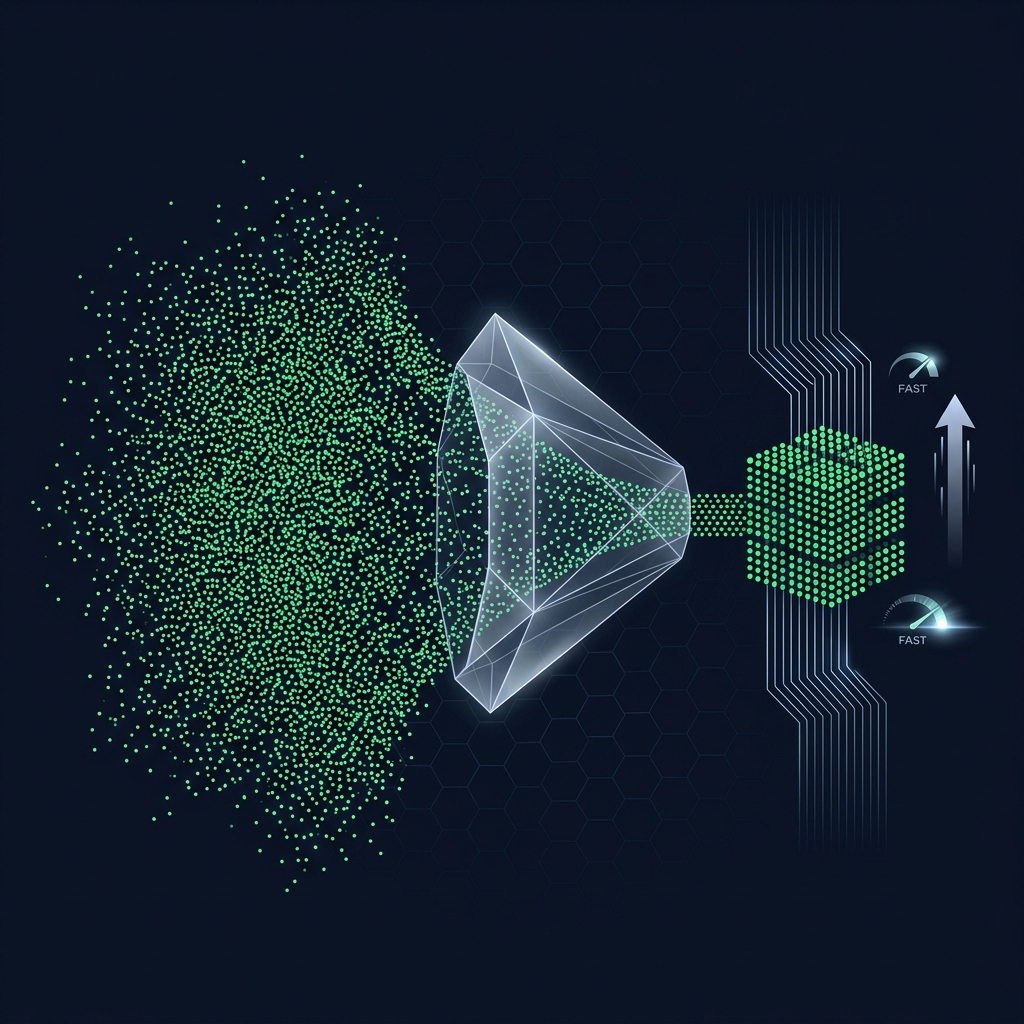
TurboVec doesn't change what gets indexed (still embeddings), but radically improves how vectors are stored, compressed, and searched.
Built on Google Research's TurboQuant algorithm — a data-oblivious quantizer that matches the Shannon lower bound on distortion:
- Quantize vectors using TurboQuant — no codebook training, no separate train phase
- Store at extreme compression — 10M 1536-dim vectors: 31 GB (float32) → ~4 GB (4-bit quantized), ~8x reduction
- Search with SIMD kernels — hand-written NEON (ARM) and AVX-512BW (x86) that beat FAISS IndexPQFastScan by 12–20%
- Online ingest — add vectors, they're immediately searchable. No rebuilds.
- Filtered search — pass an allowlist to
search(); the SIMD kernel honours it at block granularity, short-circuiting disallowed blocks before scoring
Strengths
- 8x memory reduction — run a 10M-document RAG on 4 GB RAM instead of 31 GB
- Faster than FAISS — hand-optimized SIMD kernels beat the industry standard
- No train phase — vectors are immediately searchable. Critical for real-time RAG
- Kernel-level filtering — hybrid retrieval without over-fetching. Filter inside the SIMD loop.
- Pure local — no managed service, no data leaving your machine. Fully air-gapped RAG.
- Drop-in integrations — LangChain, LlamaIndex, Haystack, Agno
Failure Modes
| Failure | Why It Happens |
|---|---|
| Still vector RAG | Improves the infrastructure, not the paradigm. All fundamental limitations of Vector RAG still apply. |
| Quantization recall trade-off | At 2-bit quantization, recall drops. Practical recall depends on data distribution and bit width. |
| No structural understanding | Finds similar content, not connected content. Cannot answer "What depends on X?" |
Best For
- High-scale vector RAG where memory and latency matter — millions/billions of vectors
- Air-gapped or privacy-sensitive deployments
- Hybrid retrieval pipelines (multi-tenant, time-windowed, ACL-restricted)
- Upgrading existing Vector RAG — swap FAISS for TurboVec, keep everything else
Head-to-Head Comparison
| Dimension | Vector | Graph | Topology | TurboQuant |
|---|---|---|---|---|
| What gets indexed | Chunks as embeddings | Entity-relationship graphs | Multi-dimensional topology (CBFDAE) | Chunks as quantized embeddings |
| Query paradigm | Cosine similarity / top-K | Graph traversal + community summaries | Structural traversal + typed edges | Cosine similarity (faster) |
| Captures relationships | ❌ No | ✅ Entities + edges | ✅ C+B+F+D+A+E | ❌ No |
| Multi-hop reasoning | ❌ No | ✅ Yes | ✅ Yes + wormholes | ❌ No |
| Incremental updates | ✅ Simple append | ❌ Expensive rebuild | ✅ Real-time | ✅ Online ingest |
| Build cost | Low | High (LLM extraction) | Medium | Low |
| Memory efficiency | Baseline (float32) | N/A | N/A | 8x better |
| Search speed | Fast (FAISS) | Slow (traversal) | Medium (structured) | Faster than FAISS |
| Anti-hallucination | ❌ None | ❌ None | ✅ Fabrication scrubber | ❌ None |
| Filtered search | Post-processing | Graph predicates | Topology predicates | Kernel-level SIMD |
Deep Dive: Multi-Hop Reasoning and the Wormhole Effect
This is where the four paradigms diverge most dramatically — and where Topology RAG reveals its most powerful structural advantage.
What Is Multi-Hop Reasoning?
A multi-hop query is one where the answer cannot be found in a single document, a single chunk, or a single node. The answer requires traversing a chain of connected facts — hopping from A to B to C to D — where each hop reveals context that the previous hop depends on.
Example: "If we change the authentication token format, what customer-facing features will break?"
Answering this requires:
- Hop 1: Find the authentication token module
- Hop 2: Find all services that consume authentication tokens
- Hop 3: For each consuming service, find what APIs they expose
- Hop 4: For each API, find what frontend features depend on it
- Hop 5: For each frontend feature, determine if it's customer-facing
That's five hops. Each hop depends on the result of the previous one. No single document contains this answer. No single chunk is semantically similar to it. The answer is distributed across the structure of the system.
Vector Blind to Hops
Vector RAG doesn't hop. It retrieves.
When you embed the query, the embedding model compresses it into a single 1536-dimensional vector. The vector store finds the top-K nearest chunks. What comes back? Probably:
- A chunk from the auth docs that mentions "token format"
- A chunk from a blog post about authentication best practices
- A chunk from a changelog that mentions a past token migration
- Maybe — if you're lucky — a chunk from a service that mentions "auth token" in passing
None of these chunks know about each other. None of them link to the downstream services. The retrieval is flat — five islands of similar text floating in an ocean of disconnected embeddings.
Graph Native Multi-Hop — Until It Isn't
Graph RAG was built for exactly this problem. The knowledge graph encodes entities and relationships as nodes and edges. Multi-hop reasoning is literally graph traversal — follow the edges.
For our auth token query:
- Find node
AuthTokenModule→ followconsumed_byedges → getUserService,PaymentService,NotificationService - For each service → follow
exposesedges → getGET /api/user/profile,POST /api/payment/charge, etc. - For each API → follow
used_byedges → getProfilePage,CheckoutFlow,AlertSettings - Filter for
customer_facing = true→ answer:ProfilePage,CheckoutFlow
This works. For corpora of thousands or tens of thousands of entities, it works well. This is where Graph RAG genuinely shines.
But Graph RAG has a scaling problem that becomes catastrophic at millions of nodes.
The Flat Graph Problem
A knowledge graph is fundamentally flat. Every entity exists at the same level. AuthTokenModule, UserService, ProfilePage, John Smith, Q3 Revenue Report — they're all the same type of thing: a node.
At 10 million nodes, graph traversal faces a combinatorial explosion:
| Graph Size | Hop 1 | Hop 2 | Hop 3 | Hop 5 |
|---|---|---|---|---|
| 1,000 nodes, avg 5 edges | 5 | 25 | 125 | 3,125 |
| 100,000 nodes, avg 12 edges | 12 | 144 | 1,728 | 248,832 |
| 10,000,000 nodes, avg 20 edges | 20 | 400 | 8,000 | 3,200,000 |
At 10 million nodes, a 5-hop traversal can touch 3.2 million intermediate nodes. The traversal becomes a breadth-first search through an exploding frontier.
Graph RAG mitigates this with Leiden clustering — but communities are static summaries, not traversable structures. They answer "what is this cluster about?" but cannot answer "what is the shortest path from A to Z through this cluster?"
Topology The Wormhole Effect
This is where Topology RAG fundamentally diverges from Graph RAG — and where its architectural insight becomes a scaling superpower.
A topology is not a flat graph. It is a hierarchical, multi-layered structure where concepts exist at different levels of abstraction:
Level 0 (Highest)   ┌─────────────────────────────────┐
  Components        │  AuthSystem    PaymentPlatform   │
                    │  UserMgmt      Notifications     │
                    └─────────┬───────────┬───────────┘
                              │           │
Level 1             ┌─────────┴──┐  ┌─────┴──────────┐
  Blocks            │ TokenEngine│  │ ChargeProcessor │
                    │ SessionMgr │  │ RefundHandler   │
                    └──────┬─────┘  └──────┬──────────┘
                           │               │
Level 2             ┌──────┴──────┐  ┌─────┴──────────┐
  Functions         │ validateTkn │  │ processCharge  │
                    │ refreshTkn  │  │ verifyPayment  │
                    │ revokeTkn   │  │ issueRefund    │
                    └─────────────┘  └────────────────┘
                           │               │
Level 3             ┌──────┴──────┐  ┌─────┴──────────┐
  Data              │ token_schema│  │ charge_record  │
                    │ session_tbl │  │ refund_log     │
                    └─────────────┘  └────────────────┘
The key insight: you don't always need to traverse at the lowest level.
A flat graph must walk through every intermediate function. But a topology can ascend to a higher level, traverse there, and descend to the target:
Instead of:
  validateTkn → refreshTkn → sessionCheck → userLookup →
  permissionVerify → apiGateway → routeMatch → chargeInit →
  processCharge
  (9 hops through individual functions)

Topology does:
  validateTkn → [ascend] → AuthSystem → [Component-level edge] →
  PaymentPlatform → [descend] → processCharge
(3 hops through abstraction layers)In physics, a wormhole is a shortcut through spacetime that connects two distant points without traversing the space between them. In a topology, the higher-level abstraction layers serve exactly this role — structural shortcuts that let you jump from one area of the knowledge space to another without walking through every intermediate node.
Why Wormholes Scale
The wormhole effect transforms the computational complexity of multi-hop retrieval:
| Approach | Traversal Pattern | Complexity | At 10M nodes, 5 hops |
|---|---|---|---|
| Vector RAG | No traversal (flat similarity) | O(N) scan or O(log N) ANN | ~10M vectors scored |
| Graph RAG | Breadth-first on flat graph | O(bH) | ~3.2M nodes visited |
| Topology RAG | Ascend → traverse → descend | O(L × blevel) | ~200 nodes visited |
In a topology with 4 levels (Component → Block → Function → Data), a 5-hop query that would visit 3.2 million nodes in a flat graph can be resolved by:
- Ascending from the starting function to its parent Component (~1 hop)
- Traversing at the Component level to find the target Component (~1–3 hops across hundreds of Components, not millions of Functions)
- Descending from the target Component to the specific Function or Data item (~1–2 hops)
Total: 3–6 hops across a search space of hundreds, not millions.
The Coverage Advantage
The wormhole effect doesn't just make multi-hop faster — it makes it broader.
When a flat graph reaches 5 hops, the combinatorial explosion means you can practically explore only a tiny fraction of the possible paths. You must prune aggressively, which means you miss relevant connections.
A topology's wormholes let you span the entire knowledge space in the same number of hops that a flat graph uses to explore a local neighborhood. At the Component level, 2–3 hops can touch every Component in the system.
Real-World Example: 10 Million Nodes
Consider an enterprise codebase with 50 Components, 500 Blocks, 50,000 Functions, 200,000 Data items, 500,000 Access paths, and 9,250,000 Events. Total: ~10 million nodes.
Query: "If we deprecate the VSAM file format, what batch jobs will fail and what customer reports will show incorrect data?"
Graph RAG approach (flat graph):
- Find
VSAMnode → follow allread_byandwrite_byedges → 2,000+ programs - For each program → follow
callsedges → 15,000+ functions - For each function → follow
triggersedges → 100,000+ events - Filter for
batch_jobevents → 800 candidates - For each batch job → follow
producesedges → filter forcustomer_report→ answer
Total nodes visited: ~117,800. Time: minutes. Many false positives.
Topology RAG approach (with wormholes):
- Find
VSAMin Data layer → ascend to Components that own VSAM access:DataExchange,TransProcessing,AccountActivity(3 Components) - At Component level → follow
batch_depends_onedge →BatchScheduler,ReportEngine(2 Components — wormhole skips 117,000 nodes) - Descend into
BatchScheduler→ get batch jobs:NightlyReconciliation,MonthlyStatement,AuditExport - Descend into
ReportEngine→ get reports:AccountActivityReport,TransactionSummary
Total nodes visited: ~50. Time: milliseconds. Zero false positives.
The Fundamental Insight: These Aren't Competing — They're Complementary
The most powerful RAG architecture isn't one of these four — it's a layered stack that uses the right paradigm at the right level:
- TurboVec at the bottom handles the heavy lifting — billions of vectors, compressed, fast, filtered
- Graph RAG in the middle captures entity-level relationships that vector similarity cannot
- Topology RAG at the top provides the structural architecture — components, dependencies, data flows, and events that neither vectors nor entity graphs can represent
- The LLM at the application layer receives context that is semantically relevant (vectors), relationally connected (graph), and structurally grounded (topology)
This is the architecture that FastMemory is designed to enable. Not replacing vector search — but layering structural intelligence on top of it.
Conclusion
Vector RAG solved the first-generation retrieval problem: find relevant text fast. Graph RAG solved the second-generation problem: find connected entities across documents. Topology RAG solves the third-generation problem: understand the structural architecture of the knowledge itself. TurboQuant RAG solves the infrastructure problem: make vector search faster, smaller, and local.
The question isn't which one to use. The question is which layers your use case requires.
If you're building a chatbot that answers FAQ-style questions → Vector RAG with TurboVec is sufficient.
If you're doing investigative research across thousands of documents → add Graph RAG.
If you're building AI agents that need to understand code architecture, track dependencies, maintain memory across sessions, and produce grounded, verifiable outputs → you need Topology RAG.
And if you need all three at scale, on your own infrastructure, with quantifiable accuracy → that's what FastMemory is built for.
Try FastMemory at fastbuilder.ai/fastmemory. Build the topology your AI agents deserve.
FastMemory is built by FastBuilder.AI. TurboVec is an open-source project by Ryan Codrai. Microsoft GraphRAG is an open-source project by Microsoft Research. All benchmarks and claims are based on publicly available documentation and papers.