Understanding Code Topology in 5D Virtual Reality
For decades, the software engineering industry has suffered from a fundamental representational failure. We have attempted to build hyper-complex, massively distributed, asynchronous logic engines using a visual interface designed for writing letters: the flat, 2D text editor.
As we transition into the era of High Velocity Engineering—where agentic AI models generate thousands of lines of code per hour—this representational failure has become a hard limit on innovation. Great Language Models (LLMs) alone are no longer enough. The future of software scaling lies not just in the parameter count or neural weights of an AI, but in the underlying mathematical topology that guides it.
This comprehensive, 4000-word analysis explores the concept of Code Topology. We will examine how hard sciences like Biology and Network Architecture have used topological mappings for years, how FastBuilder AI is bringing these niche mathematical concepts into mainstream software development, and how viewing code through UpperSpace 5D Virtual Reality completely redefines the human-machine collaboration loop.
Part 1: What is "Topology" Beyond Mathematics?
In mathematics, topology is the study of the properties of a geometric object that are preserved under continuous deformations, such as stretching, twisting, and bending, but not tearing or gluing. Topology cares about "connectedness" and "holes"—not exact distances or strict geometric shapes.
When we apply this to information systems, Data Topology refers to how distinct pieces of information are fundamentally connected and networked, regardless of their physical or syntactical location. This concept is already driving massive breakthroughs in other, older scientific domains.
Topology in Biological Data Analysis
Consider modern bioinformatics. Biology in 2025 does not look at DNA merely as a linear, 2D string of text (A, C, T, G). The massive breakthroughs in protein folding prediction—most notably by systems like AlphaFold—rely heavily on Graph Neural Networks (GNNs) and biological topological network analysis.
- Protein-Protein Interaction (PPI) Networks: Biologists map cells using network topology, where proteins are "nodes" and their physical interactions are "edges." They look for topological patterns (motifs) and "hubs" (highly connected nodes) to identify critical disease pathways.
- Spatial Transcriptomics: Researchers no longer just look at what genes are expressed; they map where in the 3D space of a tissue sample they are expressed. The spatial topology of the data defines its function.
Topology in Advanced Network Architecture
Similarly, the physical IT infrastructure running the globe has abandoned flat concepts. In 2025, enterprise network architecture relies heavily on Software-Defined Networking (SDN) and Zero-Trust Mesh Topologies.
- Self-Healing Mesh: Rather than a traditional "Hub and Spoke" (Star) topology, modern IoT and Edge Computing networks utilize overlapping mesh topologies. If a node fails, the physical topology mathematically guarantees multiple alternate pathways, instantly re-routing data.
- AI for IT Operations (AIOps): Managing these complex hybrid topologies is impossible for humans. AIOps tools ingest the entire network topology graph, allowing AI to spot security micro-segmentation failures across thousands of cloud instances by analyzing the shape of the data flow, not just reading logs.
The Software Engineering Lag CRITIQUE
While biologists map 3D protein folding graphs and network engineers utilize self-healing multi-cloud
mesh topologies, software engineers are still organizing their multi-million dollar business logic in a
generic folder structure (/src/components) and reading it line-by-line. We are
using 20th-century filing cabinets to build 21st-century artificial intelligence.
Part 2: Defining "Code Topology"
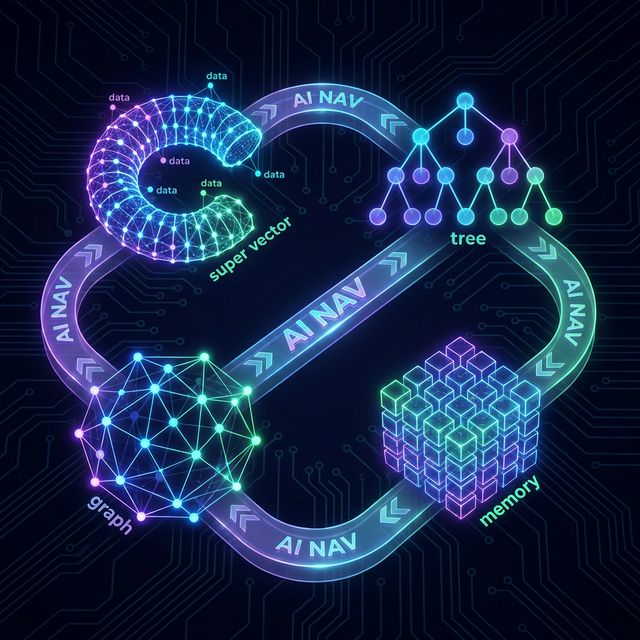
A robust codebase topology isn't a flat directory of files. It is an intricate web defined by an advanced combination of super vectors, graphs, trees, and continuous memory states. To fix the representational failure of the 2D IDE, we must map software the way biologists map proteins.
When we talk about Code Topology, we are referring to the extraction and visualization of the absolute truth of the software's architecture:
- The Execution Graph: Not where the file is stored, but what it touches. Which routes trigger which middleware, communicating with which database tables? This is a massive, directed acyclic graph (DAG).
- The State Tree: How data mutates over time across components. (e.g., How does the Redux or Zustand global state flow downward through the DOM topology?)
- The Vector Embedding Space: How semantically similar two pieces of code are. AI understands code by mapping it into a high-dimensional vector space. Code that does similar things (even across different languages or services) lives "close" together in this topology.
"When an AI agent moves through a proper topological map, it doesn't just guess what comes next based on autocomplete syntax; it knows the architectural blueprints. It navigates a well-defined conceptual space, resulting in zero hallucinated functions and significantly higher quality outputs."
Part 3: The Niche Application—Agentic Pathfinding
Why does code topology matter right now? Because we are transitioning from copilot autocomplete to fully autonomous agentic execution. Standard AI coders (like GitHub Copilot) fail at large-scale refactors because they suffer from "Architectural Blindness"—they only see the file you have open.
By enforcing a strict topological map using a Model Context Protocol (MCP), a few niche, bleeding-edge engineering teams have discovered the secret to flawless AI generation: Constrained Agentic Pathfinding.
Instead of telling an AI, "Rewrite the auth system," you pass the AI the topological graph of the auth system and say, "Traverse these specific nodes (Frontend Login Form -> API Gateway Middleware -> Auth Microservice -> Main User DB) and refactor their connections to use JWT instead of Sessions."
Because the AI is forced to navigate the mathematical topology of the codebase rather than hallucinating new files, the resulting code is structurally sound. It breaks nothing because it inherently understands the ripple effect of its actions across the graph.
Part 4: FastBuilder AI and UpperSpace 5D
Recognizing the massive gap between what AI can do and how humans manage it, FastBuilder AI has introduced a revolutionary suite of offerings designed specifically to manipulate and manage Code Topology natively.
The FastBuilder AI Model Context Protocol (MCP) Engine
FastBuilder is not just another wrapper around GPT-4. It is an infrastructure company. Their core offering is a hyper-optimized MCP engine that continuously runs in the background of your monorepo. It acts as a radar, constantly updating the Abstract Syntax Tree (AST) and topological graph of your software.
When you use an elite LLM agent (like FastBuilder's partner agents, Spec-Kit or Antigravity), the FastBuilder MCP intercepts the prompt, injects the exact topological vector graph required for the task, and ensures the AI's output mathematically aligns with the existing connections.
Enter UpperSpace 5D: Visualizing Software Architecture
But the true revolution is how FastBuilder connects the human back into this loop. To harness the power of this topological data, they developed UpperSpace 5D.
UpperSpace 5D is a local engine and viewer that abandons the flat file tree. It reads your code locally and builds a high-definition topological universe of your entire codebase.
Why 5D? INNOVATION
A standard dependency graph is 2D. A complex graph is 3D. UpperSpace goes to 5D.
- 1D/2D/3D: Spatial layout of components (Frontend, Backend, Infrastructure) utilizing organic clustering algorithms like Force-Directed Graphs.
- 4D (Time/History): Visualizing Git commit history as a dimension. You can "rewind" the topology to see how architectural debt slowly accumulated over a year.
- 5D (Semantic Vector Weight): Displaying the AI's understanding of the code. Nodes glow or shift based on semantic similarity, showing you exactly how the AI clusters the logic in its own "brain."
Part 5: Immersive Engineering in Virtual Reality
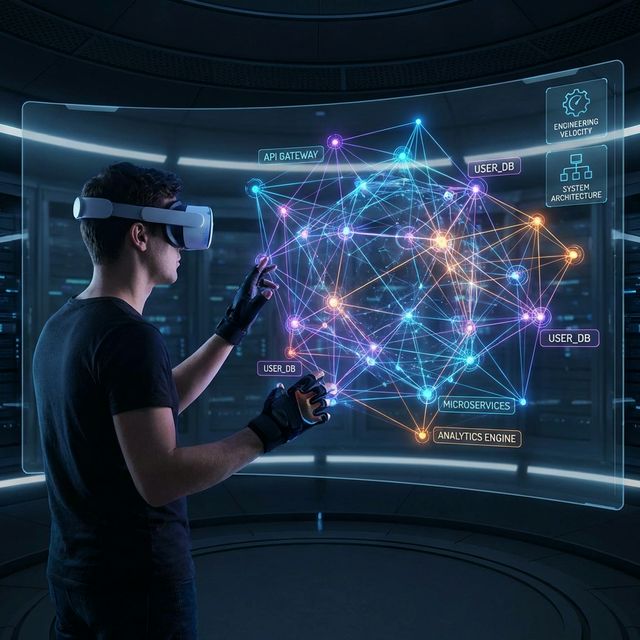
UpperSpace 5D allows you to view your architecture in a browser like a high-dimension structure, but the ultimate application of FastBuilder's technology is immersive. Developers can literally step inside their codebase.
By simulating connections between different components in 3D/XR virtual reality—utilizing consumer-grade spatial computing platforms like Meta's Horizon OS (Quest 3) or Apple Vision Pro—teams experience software fundamentally differently.
The VR Engineering Workflow
- Tactile Architecture Review: A Principal Engineer puts on a headset. The sprawling, tangled mess of an inherited legacy monolith surrounds them. Because of the topological clustering, they can physically see that the Payments Module is dangerously coupled to the User Profile UI. It looks physically tangled.
- Spatial Refactoring: With hand-tracking, the engineer grabs the Payments Module and manually pulls it away from the UI cluster.
- Agentic Trigger: This physical action within the VR topology triggers the FastBuilder MCP. The system translates the spatial movement into a command for the Antigravity AI Agent: "Decouple these routes and establish a clean event-bus interface between them."
- Visual Verification: The engineer watches in real-time as the AI writes the code, the tests pass, and the red, tangled "wires" connecting the modules snap into clean, organized, green asynchronous event pipes.
Part 6: Re-establishing Human-AI Alignment
The transition from manual coding to AI generation represents the largest shift in labor velocity since the Industrial Revolution. However, if humans cannot understand the systems the machines are building, we lose control of our own digital infrastructure.
Code Topology is the Rosetta Stone. It is the shared language between biological architects and silicon builders.
This visceral, spatial connection to code topology allows both human developers and deterministic AI to share a unified understanding of the software's structure. By forcing AI to navigate constrained topologies, and allowing humans to visualize those networks via UpperSpace 5D VR, FastBuilder AI transforms abstract, flat lines of text into a living, explorable, mathematically sound digital universe.
The Architecture of Tomorrow
You cannot manage what you cannot measure, and you cannot architect what you cannot see. The flat text editor is dead. The era of blind vibe-coding will lead to enterprise ruin.
The teams that win the next decade of High Velocity Engineering will be the ones who treat their software not as text, but as Biology. They will map the nodes, trace the topological graphs, simulate the mutations, and utilize tools like FastBuilder AI and UpperSpace 5D to orchestrate architecture with their own hands in the virtual space. Welcome to the 5th Dimension.