Introduction: The Acceleration Trap
In the rapidly evolving landscape of software engineering, agentic coding platforms like GitHub Copilot, Windsurf, Cursor, and SpecKit are profoundly transforming the fundamental nature of how developers interact with codebases. These platforms, powered by sophisticated Large Language Models (LLMs), promise unprecedented speed, seemingly turning every junior developer into a 10x engineer and every senior architect into an entire development agency.
However, this massive acceleration often comes with a hidden, catastrophic cost: the phenomenon we call "Breaks Off" coding.
As velocity increases, the human developer's capacity to comprehensively review and maintain mental models of the underlying architecture degrades proportionally. When an AI agent generates hundreds of lines of code across five separate files simultaneously, the human operator shifts from being a careful crafter of logic to a high-speed editor. This creates a critical vulnerability point where the AI subtly deviates from the intended architectural blueprint, introducing deep, systemic flaws that compile perfectly but fail disastrously under real-world logic.
Defining the "Breaks Off" Phenomenon
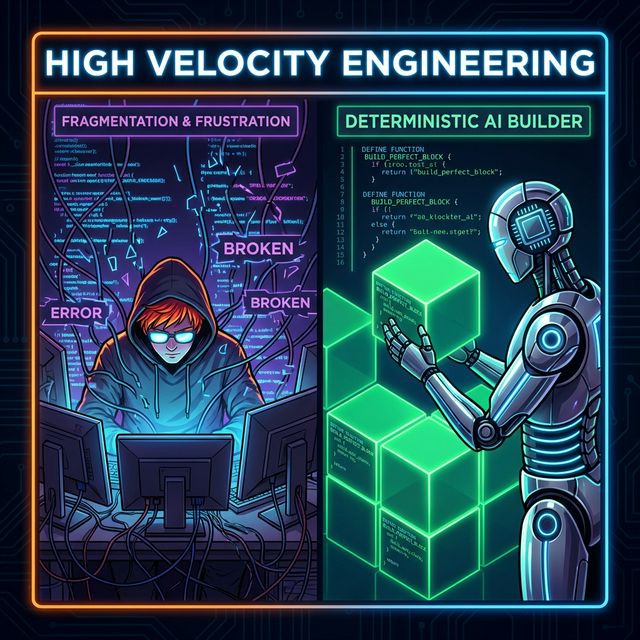
Most modern agentic coding platforms require you to enable automated decision-making at your own risk. The reality is that at the end of a long, highly productive generative session, the coder agent might abruptly "break off" the code. This occurs when the deterministic intent of the original architecture fractures under the weight of probabilistic text generation.
The developer is suddenly left to manually sift through thousands of lines of beautifully formatted, syntactically correct, but logically broken code. These errors aren't the simple missing semicolons of the past; they are "ghost bugs." A ghost bug is a deep structural hallucination where the AI invents a database column that doesn't exist, assumes an API endpoint behaves synchronously instead of asynchronously, or silently drops a crucial security guardrail because it statistically determined that the next token should be closer to a generic boilerplate pattern rather than your specific business logic.
Why does this happen? The primary reason is that current agentic platforms are structurally designed to optimize their own token usage and performance memory. They are highly advanced predictive text engines trying to guess what string of text logically follows the prompt context. The target software—your product—often doesn't get a chance to be properly optimized during the generation cycle because the AI lacks a true semantic understanding of the multi-dimensional topology of your application.
The Hallucination Crisis in AI Coding
At the core of "Breaks Off" coding is the persistent issue of LLM hallucination. In the context of creative writing, a hallucination is a quirk; in the context of enterprise software engineering, a hallucination is a catastrophic production outage waiting to happen.
Code hallucinations occur when the AI:
- Invents dependencies: Calling libraries or specific versions that have never been installed, simply because they frequently co-occur in the model's training data.
- Forgets context: Dropping essential authentication checks in a deeply nested router function because the auth context fell out of the context window limits.
- Misinterprets state: Failing to understand the difference between a globally available state manager and a local component lifecycle.
These errors are exceptionally dangerous because they sound authoritative and often look correct to an exhausted reviewer. This makes high-speed coding inherently risky if proper deterministic guardrails are not strictly embedded into the foundation of the workspace.
How the Industry Currently Attempts to Control the AI
The developer community is acutely aware of these risks, and a cottage industry of mitigation strategies has emerged over the last three years to desperately wrestle control back from the probabilistic void. Research into how developers currently try to control their codebase against rogue AI agents reveals several popular, albeit flawed, methodologies:
1. "Prompt Engineering" and Context Stuffing
The most common approach is attempting to control the AI through increasingly dense, highly specific system
prompts. Developers spend hours writing .cursorrules or complex context files detailing every
architectural standard, library preference, and syntax quirk the AI should follow. While this helps initially,
as codebases scale, the context window fills up with conflicting or outdated rules, leading to prompt
degradation where the AI simply starts ignoring instructions to save token execution time.
2. Test-Driven Agentic Development (TDAD)
Another prominent strategy is forcing the AI to write unit tests first, and only generating the implementation code to satisfy those tests. If the AI "breaks off" and introduces a hallucination, the test theoretically catches it. The fatal flaw here is that the AI writes both the test and the code. If the AI hallucinates a requirement, it will happily hallucinate a test that validates the broken requirement. Furthermore, writing thousands of boilerplate tests dramatically slows down High Velocity Engineering.
3. Linter-Driven Agentic Loops
Platforms like SpecKit and certain iterative scripts attempt to reign in the AI by running the generated code through static analysis tools (linters, type checkers like TypeScript or Rust's borrow checker) and automatically feeding the errors back to the AI. "You made a type error on line 42, fix it." The AI then apologizes and tries again. While effective for simple syntax errors, this method frequently causes the AI to fall into infinite loops—fixing one type error by breaking another function entirely because the linter has no concept of the overall business logic.
4. Model Context Protocol (MCP) Tethers
The most advanced current mitigation is using the Model Context Protocol to tie the AI to real-time external data—allowing it to read live database schemas or check actual API statuses before writing code. While MCP is a massive leap forward (and something we fully support), it still treats the codebase as a series of flat text configurations. It doesn't solve the core issue: the AI fundamentally does not understand the architectural topology.
What works? Small, isolated, tightly bounded tasks. What doesn't work? Asking an AI to refactor an entire monolithic service architecture spanning forty files. All current solutions are ultimately just band-aids on top of next-token prediction algorithms.
The Critical Shift: From Text to Topology
The ultimate realization in advanced engineering circles is that the flat-file paradigm—viewing code as massive lists of text strings hidden inside nested folders—is the root cause of the "Breaks Off" problem. You cannot control a 5-dimensional interconnected software product by reading it like a linear novel.
This is where FastBuilder.AI fundamentally shifts how human operators interact with generated code. We reject the premise that code is merely structured text. Code is a topological map of interactions, states, and data flows.
Introducing VGTM: Visual Golden Topology Mesh
To eliminate hallucinations and give developers absolute, granular control over massive AI code generation, FastBuilder.AI has pioneered the Visual Golden Topology Mesh (VGTM).
VGTM represents a total paradigm shift. Instead of giving an AI a prompt and hoping the resulting text files compile, VGTM acts as a definitive "super layer" of semantics and visual engineering controls resting directly above the raw code.
The Golden Mesh breaks your entire application down into our proprietary CBFDAE standard:
- C - Component: The macro-level independent units of the application (e.g., Auth Service, Payment Gateway).
- B - Block: Groupings of functional atoms serving common purposes within a component.
- F - Function: The atomic units of logic.
- D - Data: The exact structural models transitioning across functions.
- A - Access: Deterministic security and role restrictions mapped to every node.
- E - Event: The external and internal triggers that flow through the architecture.
How VGTM Empowers the Developer over the AI
VGTM is not a background process; it is your primary interactive control surface. By visually representing the codebase as a connected, interactive graph (accessible even in 5D Virtual Reality via UpperSpace), VGTM changes the rules of engagement with AI generation in three critical ways:
1. Semantic Enforcement Over Probabilistic Guessing
With VGTM, the AI is no longer allowed to just "guess the next line" based on GitHub training data. It is violently bound to the semantic rules of the Golden Mesh. If the AI attempts to hallucinate a database call in a UI Component block, VGTM hard-blocks the generation at the mesh layer. The architectural rule is enforced deterministically: Functions in this block do not have Edge access to Database data nodes. The hallucination is intercepted before a single character of raw code is ever written to disk.
2. Unprecedented Visual Engineering Controls
Developers no longer read through a thousand lines of Diff changes to check for "breaks off" errors. Instead, when the AI suggests a multi-file refactor, the VGTM interface visually highlights the proposed changes to the topology itself. You see exactly which new Data nodes are being created, what new Access patterns are required, and what Events are triggering them.
You can literally grab an Event node in the visual mesh, drag a restriction line to an Access node, and instruct the system: "Ensure no database queries escape this boundary." The AI then generates the underlying code to match your visual, semantic constraints. You are controlling the AI through architecture, not chat prompts.
3. Implicit Edge Mapping via Louvain Clustering
Modern applications hide complexity behind frameworks. A button click in HTML indirectly triggers a JavaScript payload which indirectly mutates a state store, which indirectly calls an API. Traditional AI loses context across these implicit bounds. VGTM utilizes advanced mathematical topology and Louvain clustering techniques to explicitly map these implicit framework connections. The AI is fed the pre-calculated, explicitly mapped topology structure. It cannot 'forget' that the React component relies on the Rust backend struct, because VGTM has locked the semantic edge in place.
Conclusion: True High Velocity Engineering
The era of treating AI coding assistants as sophisticated auto-completes is over. As codeforces scale to millions of lines governed by Autonomous Agents, we can no longer rely on manual text review to prevent "Breaks Off" coding. Leaving the AI to probabilistically wander through a codebase is a recipe for silent, catastrophic tech debt.
FastBuilder.AI and the Visual Golden Topology Mesh return absolute sovereign control back to the human architect. By elevating the control interface from flat text files to a rich, semantic, rigidly constrained 5D topology layer, we don't just speed up development—we mathematically guarantee its structural integrity.
You no longer have to worry about cleaning up after your AI assistant or reading through fragmented code streams with quiet dread. With VGTM as your engineering super layer, it is finally time to embrace true High Velocity Engineering with total, deterministic confidence.