The Developer Skills of the Future: 5D Architecture and AI Sync
The definition of a "Senior Engineer" is undergoing a radical, unprecedented transformation. For decades, the tech industry measured developer prowess by lines of code written, algorithms efficiently implemented, and deep, specialized knowledge of specific programming languages or frameworks. Today, merely knowing how to write complex algorithms or configure databases is no longer enough to secure a future in software engineering. The tech job market is shifting violently beneath our feet, driven by an exponential curve in generative artificial intelligence.
We are entering an era where AI agents and copilots can generate thousands of lines of structurally sound code in a matter of minutes. As a result, the fundamental value proposition of a human developer has changed. The premium is no longer on syntax memorization or manual typing speed. Instead, the essential skills of the future revolve entirely around managing the IDE, navigating massive code topologies, orchestrating complex systems, and achieving pure, frictionless synchronicity with AI agents.
This comprehensive 4,000-word analysis will explore the deep data behind this generational shift, drawing on the latest research from LinkedIn, the World Economic Forum (WEF), and Gartner. We will deconstruct the dying skills, dissect the emerging roles, and explain why 5-dimensional (5D) architecture and tools like UpperSpace 5D are not just novelties, but absolute necessities for survival and dominance in the software development landscape of the late 2020s.
Part 1: The Death of "Just Coding" – What the Data Tells Us
To understand where software engineering is going, we must first look at what is actively dying. The data from major employment networks and analyst firms paints a stark reality: roles that focus strictly on manual execution, repetitive scripting, and siloed component building are in rapid, irreversible decline.
Jobs Displaced Globally
According to the World Economic Forum's latest "Future of Jobs Report," while AI and information-processing technologies are projected to create 170 million new jobs globally by 2030, they will simultaneously displace 92 million existing roles. Among the hardest hit within the tech sector are basic coders and manual testers.
The LinkedIn Skills Horizon: A Case Study in Obsolescence
Recent trend analyses from LinkedIn for the 2024–2025 cycle highlight a massive realignment. Historically "safe" tech positions are now flagged as highly susceptible to AI automation. Specifically, roles defined by the phrase "just coding" are facing an extinction-level event.
What does "just coding" mean? It refers to developers who take a highly detailed, pre-architected ticket and simply translate that human logic into machine logic using Python, JavaScript, Java, or C++. Because Large Language Models (LLMs) operate fundamentally as translation engines, they are exceptionally skilled at translating human language (requirements) into programming languages (code). If a developer's primary job is this translation layer, they are competing directly against models that cost pennies per hour to operate and work instantly.
LinkedIn data highlights three specific areas experiencing sharp declines in hiring demand:
- Manual QA and Testing Roles: As AI agents become capable of not only writing code but also autonomously writing comprehensive unit tests, integration tests, and running adversarial edge-case scenarios, the role of human manual software testers is shrinking drastically.
- Shallow Front-End Development: Roles focused purely on translating Figma designs into basic HTML/CSS without deep interactivity or architectural complexity are being heavily automated by design-to-code AI pipelines.
- Siloed Specialists: Highly specialized developers deeply entrenched in a single, static technology stack without a broader business or architectural context are finding their skills obsolete. A narrow focus is a fatal vulnerability in an era of rapid technological pivot.
The Gartner Reality Check for 2027
If LinkedIn shows the current hiring sentiment, Gartner predicts the structural reality of the engineering enterprise. Gartner's sweeping analysis of the software engineering workforce indicates a tectonic shift driven by Generative AI.
Of Engineers Will Need Upskilling
Gartner predicts that Generative AI will necessitate a massive upskilling of the software engineering workforce through 2027, with a staggering 80% of engineers requiring fundamentally new skills to remain relevant.
By 2028, Gartner anticipates that 90% of enterprise software engineers will utilize AI code assistants, a massive jump from less than 14% at the beginning of 2024. The implications of this are profound. It means that within a few short years, the vast majority of enterprise code will be AI-generated rather than human-authored. As Gartner points out, this shifts the human role from "primary code writers" to "orchestrators of AI systems."
Part 2: The New Core Competencies of the AI-Native Engineer
If manual coding is dying, what replaces it? The answer lies in the World Economic Forum's identification of the fastest-growing skills. At the top of the list are Analytical Thinking, AI Literacy, and Systems Architecture.
The "AI-native software engineer" that Gartner describes does not spend eight hours a day in a terminal typing out syntax. Instead, they spend their time guiding AI agents with relevant context, constraints, and deep architectural intent. They are the directors of an AI chorus.
The Rise of Prompt Engineering and RAG
LinkedIn's "Skills on the Rise" reports emphasize that proficiency in LLM Application, Natural Language Processing (NLP), and Prompt Engineering are now critical competencies. However, this is not the basic "prompt engineering" of simply asking ChatGPT a question. In a high-velocity engineering context, prompt engineering means constructing complex, multi-layered constraints that guide autonomous agents through vast codebases.
Furthermore, Gartner highlights Retrieval-Augmented Generation (RAG) as an essential skill. Engineers must understand how to feed AI agents the correct contextual data—the exact state of the database, the specific microservice dependencies, and the overarching business logic—so the AI can generate accurate, architecturally compliant code.
From Translators to Orchestrators
The human developer is moving up the abstraction stack. Decades ago, developers moved from punch cards to assembly language, then from assembly to high-level languages like C, and then to managed languages like Java and Python. Each step abstracted away tedious details, allowing developers to build more complex systems faster.
AI is the ultimate abstraction layer. We are moving from writing human-readable code to writing intent. The orchestrator must understand system design, security, latency, and topological dependencies. They must be able to look at a sprawling microservices architecture and instinctively understand how an AI-generated change in one service will ripple through the data pipelines to affect the entire ecosystem.
Part 3: The Crisis of the 2D IDE in an Era of High Velocity
As the developer transitions into the role of an orchestrator managing AI agents that output code at hyper-speed, a massive structural bottleneck emerges: The Integrated Development Environment (IDE).
Traditional IDEs—VS Code, IntelliJ, Eclipse—were built for human typists. They are designed as 2D text editors where a human opens a file, scrolls through lines of code, and types. They organize information in flat, hierarchical file trees. This interface was perfectly adequate when a developer produced 100 lines of solid code a day.
However, when you deploy an agentic coder like Spec-Kit or Antigravity, they might generate 1,000 to 5,000 lines of code across 30 different files in ten minutes. The human developer, acting as the orchestrator and reviewer, is suddenly overwhelmed. How do you review 5,000 lines of generated code in a 2D text editor effectively? You can't. The cognitive load of switching tabs, opening folders, and manually tracing variable references across dozens of modified files is simply too high.
"The traditional 2D IDE—with its flat file trees and endless scrolling—is the primary bottleneck preventing organizations from achieving true High Velocity Engineering. It is entirely inadequate for the AI-orchestrator."
The Limits of Human Working Memory
Cognitive science tells us that human working memory can hold roughly 7 (plus or minus 2) items at a time. When navigating a complex, AI-generated refactor spanning front-end components, backend APIs, and database schemas, the developer's working memory is instantly flooded. The 2D IDE provides no spatial context. It forces the developer to hold the invisible architecture of the software in their mind while staring at flat text.
This leads to the dreaded "Breaks Off" coding phenomenon. The AI generates code at breakneck speed, but the human orchestrator loses track of the architecture. The code breaks, bugs are introduced, and the perceived velocity gains are lost in hours of tedious, painful manual debugging in a flat 2D environment.
Part 4: Moving Beyond Text – The Necessity of Higher Dimensional Architecture
To orchestrate at high velocity, developers must embrace higher-dimensional tools. The solution to the cognitive overload of the 2D IDE is to fundamentally change how we visualize and interact with software codebases. We must move from reading code to navigating topologies.
A codebase is not a book; it is not meant to be read linearly from top to bottom. A codebase is a living, breathing city. It has highways (data pipelines), skyscrapers (core monoliths), and intricate electrical grids (dependency graphs). To manage a city, a mayor does not read a list of coordinates; they look at a highly detailed, multi-dimensional map.
Enter UpperSpace 5D: Visualizing the Unseen
This is the engineering philosophy behind UpperSpace 5D. UpperSpace 5D is not just another code editor; it is a revolutionary spatial environment for software orchestration.
With UpperSpace 5D, developers read their entire codebase locally, and the software builds a high-definition, mathematical topology—a dynamic, visually explorable map of their software architecture. It maps the structure of your code using Super Vectors, Graph theory, Tree logic, and deep continuous memory.
The Anatomy of 5D Topology
True 5D Code Topology incorporates:
- Spatial Graphs (3D): Visual representation of files, functions, and classes as nodes in 3D space, showing physical weight and gravity based on code complexity.
- Temporal Axis (4D): The ability to scrub back and forth through Git history, watching the architecture expand, contract, and evolve over time gracefully.
- Execution/Data Flow (5D): Real-time simulation of data passing between nodes, illuminating the glowing paths of execution traces, API calls, and logic branches.
VR and Spatial Computing: The New Developer Interface
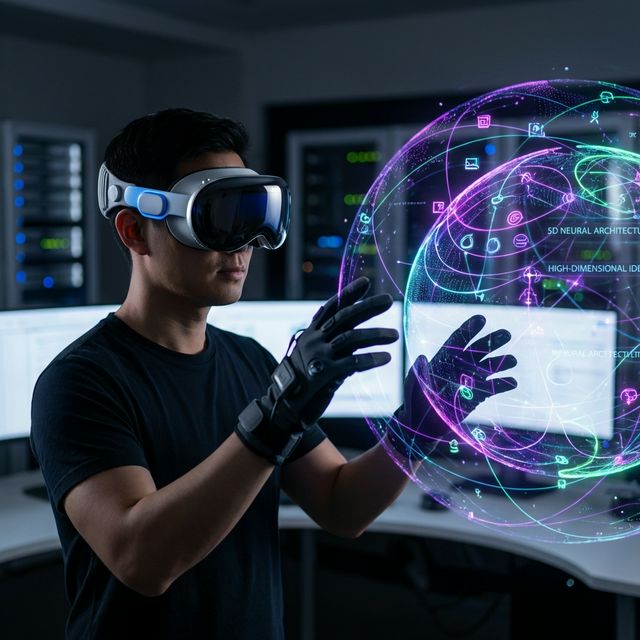
While viewing a 3D architecture on a flat screen is a massive upgrade over a file tree, the true paradigm shift occurs when developers utilize spatial computing. UpperSpace 5D integrates with 3D virtual reality environments like Meta's Horizon World or Apple VisionOS.
By donning a spatial headset, developers can literally step inside their codebase. They can physically walk around a heavily coupled legacy monolith, seeing the tangled dependency lines stretching like physical vines. They can reach out and manipulate the connections between disparate code components with their hands. They can visually trace an execution path from an edge-node API gateway deep into the secure vault of a payment processing backend.
This visceral, physical connection to code topology allows human developers to understand massive systems organically and intuitively, bypassing the bottleneck of flat-text reading. It turns abstract lines of backend logic into a tangible, explorable digital universe.
Part 5: Achieving True Human-AI Synchronicity
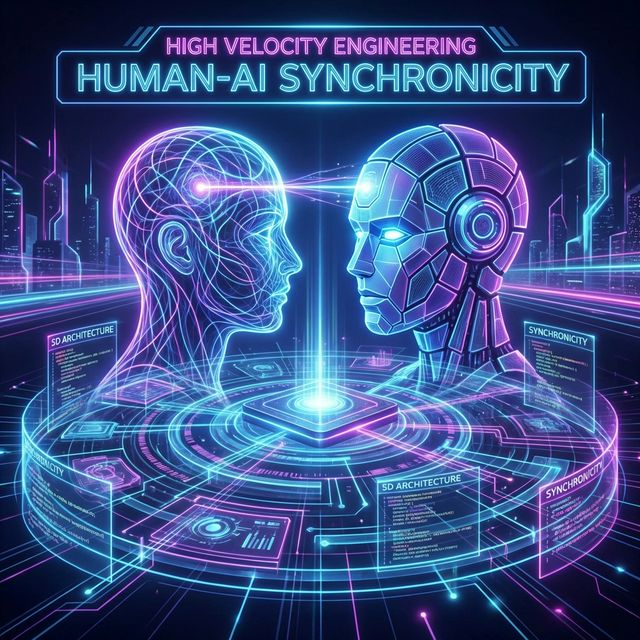
This 5-dimensional architecture is the absolute key to the ultimate developer skill: Human-AI Synchronicity.
The problem with early AI coding assistants was that they lacked deep context. You would ask an AI to write a function, and it would do so perfectly in isolation, but when you pasted that function into your 5-million-line monolithic enterprise app, it would crash the entire build because it didn't know about specific global state configurations or deeply nested dependency overrides.
To fix this, we created the Model Context Protocol (MCP). The MCP feeds the AI agent the exact state of the environment, giving it the context it needs. But even with MCP, if the human and the AI don't share the same mental model of the software, friction occurs. The human prompts the AI to build X; the AI builds X taking a route the human didn't anticipate, confusing the human and leading to broken architectures.
Sharing the Topology
With UpperSpace 5D, the human and the AI agent are navigating the exact same multi-dimensional topology.
When you stand inside your VR workspace and look at the glowing, interconnected nodes of your application, the AI sees exactly what you see. The Super Vector Graph structure that the human is visualizing is the exact mathematical grid that the AI is using for vector search and RAG retrieval.
When miscommunications vanish, velocity skyrockets. The AI understands the physical constraints of the architecture just as well as you do. When you prompt the agent to refactor a complex microservice, you don't just type text; you can spatially target a node cluster in the 5D environment and instruct the agent: "Decouple this red cluster from the blue central hub and spin it up as an independent gRPC service."
The AI agent executes the change with deterministic precision, fully aware of the ripple effects across the entire super vector graph. As the AI writes the thousands of lines of code, you don't read them line by line; you watch the 5D topology physically reshape itself in real-time, verifying visually that the dependencies are resolving correctly.
Part 6: The Elite AI Agents of High Velocity
Achieving this level of synchronicity requires not just the right 5D environment, but the right AI agent. As Gartner points out, organizations must invest heavily in AI developer platforms. But which agents are currently capable of managing complex topologies?
Based on rigorous stress-testing inside high-velocity architectural environments, two platforms currently dominate the landscape of structural awareness:
- Spec-Kit: Spec-Kit is currently the unparalleled leader in grasping deep topological context. It doesn't just write code; it reads the surrounding architecture and executes significant, multi-file architectural changes with frightening deterministic precision. It acts less like an autocomplete engine and more like a senior staff engineer executing a master plan.
- Antigravity: Working as the engine behind many of our internal processes, Antigravity brings immense, brute-force power to refactoring and rapid generation. When constrained and guided by a robust MCP topology mapped by UpperSpace, Antigravity functions as an incredibly fast executor of complex logic.
Using standard autocomplete plugins built for 2D text generation inside a cutting-edge 5D topological environment is like putting bicycle tires on a Formula 1 car. To achieve High Velocity Engineering, you must pair the spatial architecture of UpperSpace with elite, topologically aware agents like Spec-Kit.
Part 7: Preparing for 2027 – The Strategic Roadmap
The timeline given by Gartner is not abstract; it is an aggressive, rapidly approaching deadline. By 2027, the gap between organizations utilizing AI-native software engineering and those relying on manual typing will be unbridgeable. The productivity multipliers will be too vast.
If you are an engineering leader, a CTO, or a developer trying to secure your career, the roadmap is clear:
- Stop Competing with the Machine on Translation: Abandon the mindset that your primary value is typing syntax quickly. The machine has won that war.
- Embrace Systems Architecture: Deepen your understanding of how highly distributed, complex systems interact. The AI can build the brick; you must be the architect who designs the cathedral.
- Master Prompt Engineering and RAG Integration: Understand how to feed an AI the exact constraints, context, and environment variables it needs to succeed.
- Adopt Spatial Code Visualization: Transition away from flat 2D file trees. Adopt tools like UpperSpace 5D to visualize and manage software topologies organically.
- Integrate Elite Agents: Embed topologically aware agents like Spec-Kit and Antigravity deep into your CI/CD and localized development pipelines.
Conclusion: The Dawn of the Orchestrator
We are standing at the precipice of the most exciting era in the history of software development. The data from LinkedIn, the World Economic Forum, and Gartner all point to the exact same conclusion: the era of "just coding" is over, replaced by the era of High Velocity Engineering.
The developers of the future will not be hunched over keyboards staring at scrolling text on multiple monitors. They will be immersive orchestrators, manipulating vast 5D spatial topologies with their hands, working in seamless, frictionless synchronicity with elite AI agents that execute logic at the speed of thought.
The skills required to thrive in this new world are radically different, demanding a blend of high-level architectural cognition, spatial reasoning, and AI orchestration. But for those willing to adapt, to step inside the codebase and master the topology, the potential to build incredible, world-changing software is entirely limitless. Welcome to the future.