Beyond the Vector: From Semantic Slop to Topological Truth
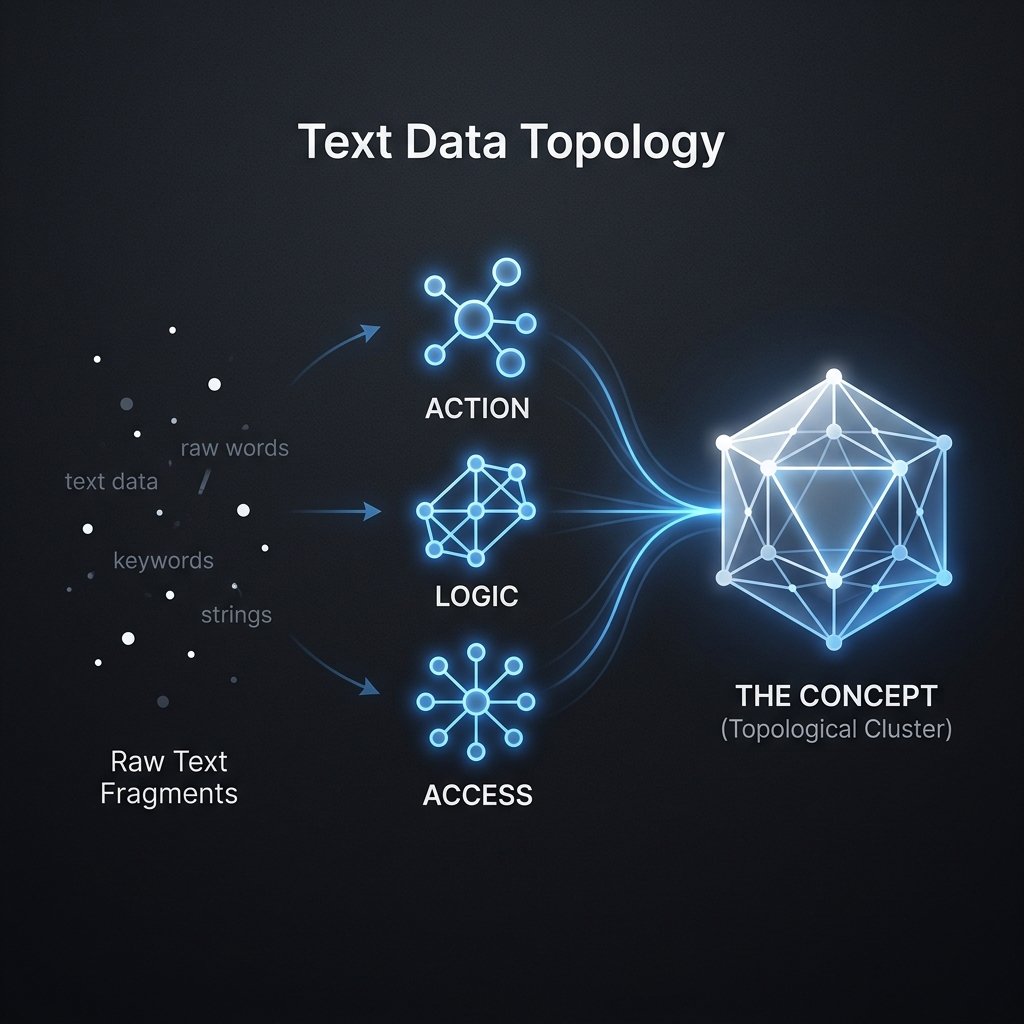
"Your AI isn't hallucinating because it's 'dumb'; it's hallucinating because your RAG architecture is blind to the logic of your data. It's time to build the buildings, not just the roads."
🏗️ The RAG Ceiling: Why Vector Search is the New Technical Debt
Over the last 24 months, the software engineering world has undergone a collective realization: Retrieval-Augmented Generation (RAG) is not an architecture — it’s a probabilistic guess.
We’ve all seen the pattern. An enterprise builds a RAG-based AI agent to query their 10-K filings or codebase. It works on basic questions. But the moment you ask it a forensic, multi-hop question — "What was the Gross Margin delta after the FY2022 COGS adjustment?" — the system collapses.
It retrieves a 2021 revenue snippet and a 2022 COGS line item, synthesizing them into a confident lie. This is the Semantic Slop. It happens because standard Vector RAG is fundamentally "road-based." It utilizes cosine similarity to calculate the distance between word embeddings, which often leads to the "Lost in the Middle" syndrome where critical context fragments are ignored.
🏢 Topology in Text: The "Buildings vs. Roads" Analogy
Imagine navigate a city using only a map of the roads. You see how to get from A to B, but you have no idea what is inside the buildings. You lack floor plans and security rules.
Standard RAG is a map of roads. It finds "relevant" text chunks based on proximity. FastMemory is a map of the buildings. We use Topology Architecture (Action-Topology Format) to treat every document not as a string, but as a traversable logical structure with strict internal boundaries.
🧠 The Physics of Context: How "Crystalline Concepts" are Born
FastMemory utilizes high-speed Louvain Community Detection to derive structure from chaos. Traditional RAG treats info as a flat list. FastMemory treats it as a Molecular Topology. By running our Rust-based clustering engine, we automatically derive Concepts.
By querying for a Concept, your AI agent is instantly "locked" into a specific logical room. It is physically impossible for the agent to pull "Ingress Logic" when reasoning about "IAM Roles." This isolation is the absolute antidote to hallucination.
🏆 11 Benchmarks of SOTA Domination
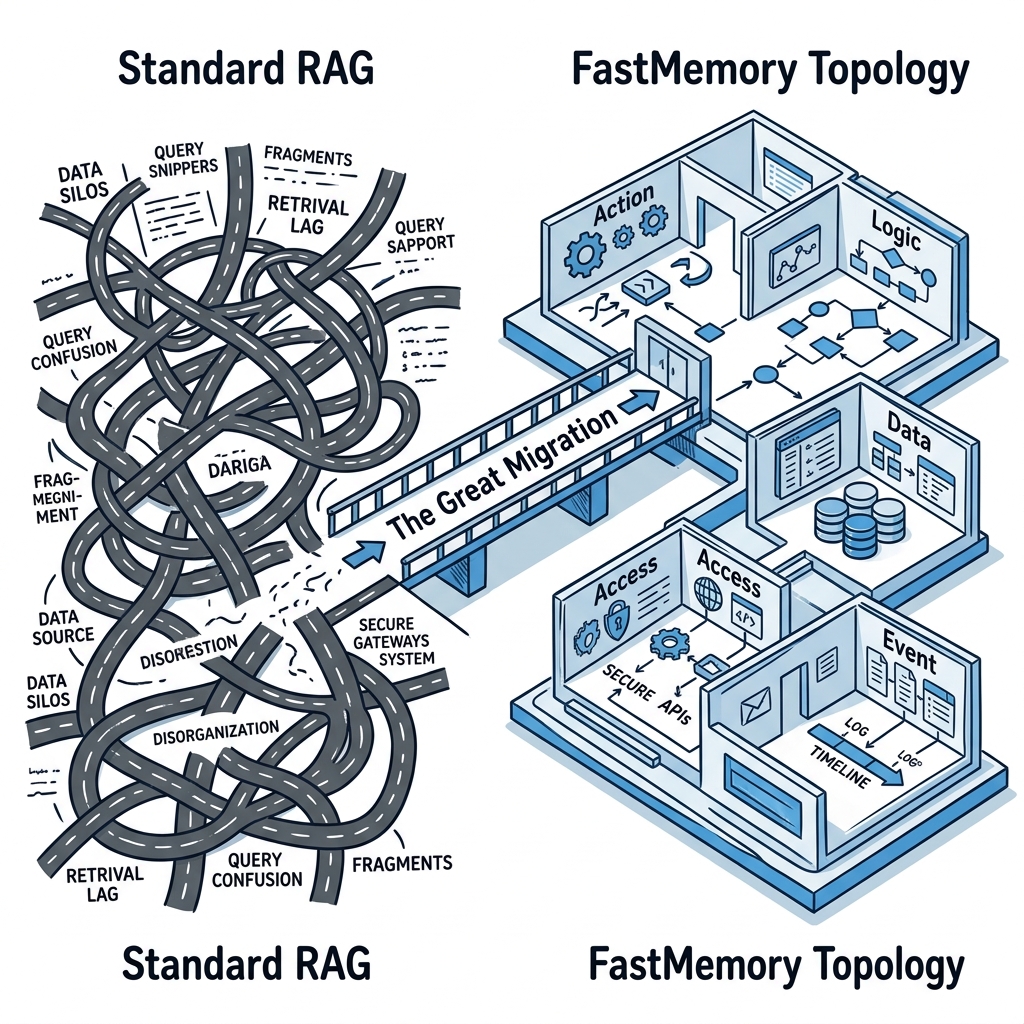
🚀 The 5-Minute Migration Guide: From Vectors to Truth
- Atomization (ATF Format): Take your core principles and format them into Action-Topology Markdown. Give your knowledge a "Logical Heart."
- Clustering (FastMemory): Pass your ATF text into the Rust engine to instantly derive the "Horizontal Layer of Truth."
- Grounding (The Tool): Update your LangChain loops to use deterministic grounding, locking the AI into the retrieved topological context.