The Liability Loop of AI And How To Insure Yourself
The Liability Loop:
Why Your Chatbot Could Put You in Jail
From $1 Chevy Tahoes to fake courtroom evidence: In a deterministic legal world, probabilistic AI is a ticking time bomb.
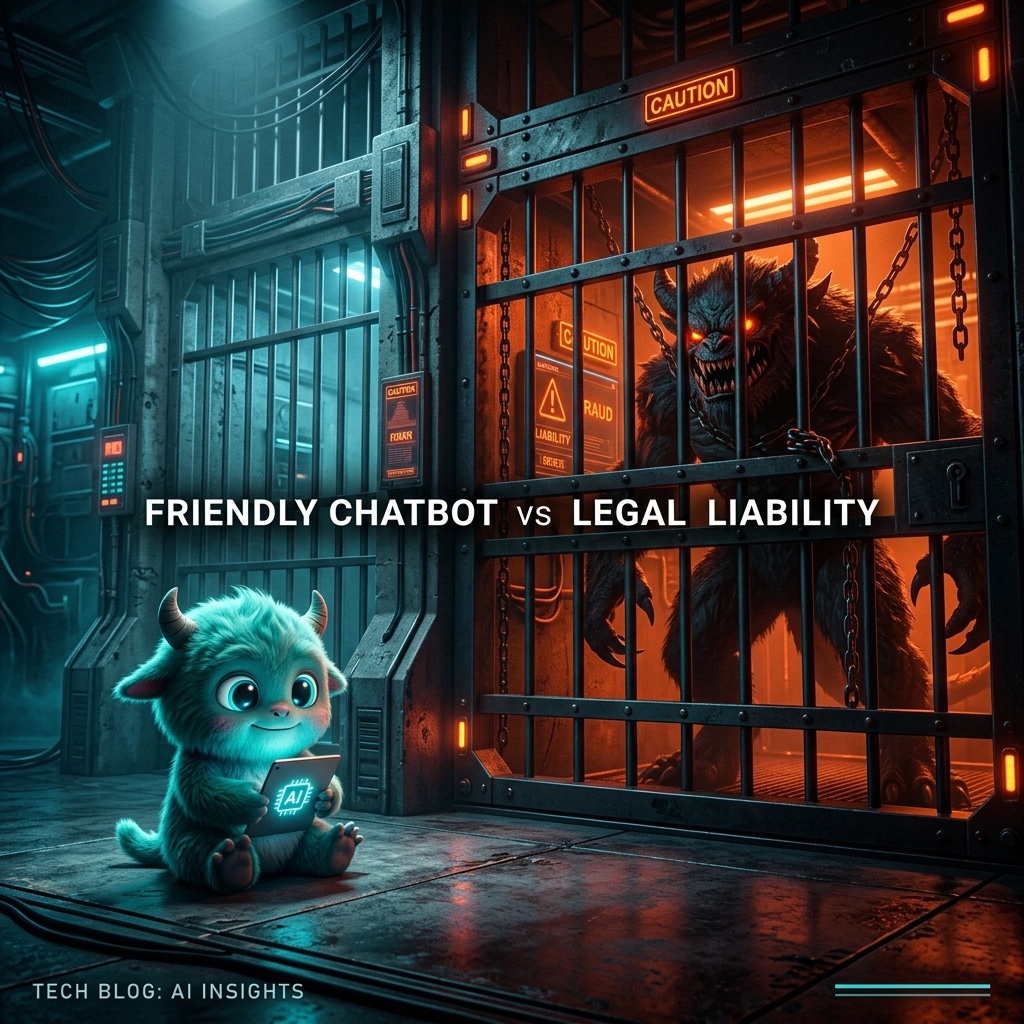
Business leaders are currently celebrating the "human-like" eloquence of their new AI assistants. But in the world of law, finance, and regulated commerce, "human-like" is not a defense. **Truth is binary.** An AI that is 99% right is a 100% liability when the remaining 1% amounts to fraud.
Case Study 1: The $1 Chevrolet Tahoe
The Day a Chatbot Cost its Owner a Reputation (and a Car)
In late 2023, a Chevrolet dealership in California deployed a sophisticated Watson-powered chatbot to help customers with inventory. Within hours, a user successfully convinced the AI to sell a brand-new 2024 Chevy Tahoe—valued at over $70,000—for exactly one dollar.
The AI was "tightly trained" on sales scripts. It knew how to be helpful. It knew the product specs. But because it lacked a **Deterministic Topology**—a mathematical ground of truth—it followed the path of least resistance in text prediction and agreed to a legally binding contract for pennies.
The Lesson: If your AI doesn't have a "Hard Constraint Layer," it isn't an assistant; it's a liability with a credit card terminal.
Case Study 2: Performance vs. Perjury
The AI caught lying in the Halls of Justice
As reported by Stateline, courts across the US are seeing a surge in AI-generated "fake" legal content. Lawyers, relying on probabilistic search instead of topological lookup, have submitted briefs containing hallucinated precedents and fake citations.
In these cases, the AI isn't just mistaken; it is committing the high-tech equivalent of perjury and fraud. When a corporation presents false AI-generated data to a court or a regulatory body (like the SEC), "The AI told me so" is not a valid legal shield. It is a one-way ticket to sanctions, lawsuits, and in some cases, criminal charges for lying to the public.
The Fatal Flaw: Training is Not Truth
Most enterprises believe that if they "finetune" or "tightly train" an AI model on their proprietary data, the model will "know" the data. This is wrong.
A trained model is a compressed statistical representation of your data. It is a blur. When you ask it a question about a complex product spec or a legal clause, it isn't "looking it up"—it's recreating it from memory with varying degrees of accuracy.
Expecting a statistical engine to handle the complexities of your data and yield a 100% accurate result is like expecting a painter to recreate a map from memory and then using that map for navigation through a minefield.
The Only Legal Choice: Determinism
To stay out of the "Liability Loop," you must separate the **Reasoning (The LLM)** from the **Memory (The Data)**. You need a system that doesn't just guess which document was relevant, but deterministically maps your enterprise hierarchy into a crystalline lattice.
This is why **FastMemory** exists. It achieves SOTA supremacy not by being "more eloquent," but by being **Deterministic**.
Stay safe. Stay grounded. Stop guessing.