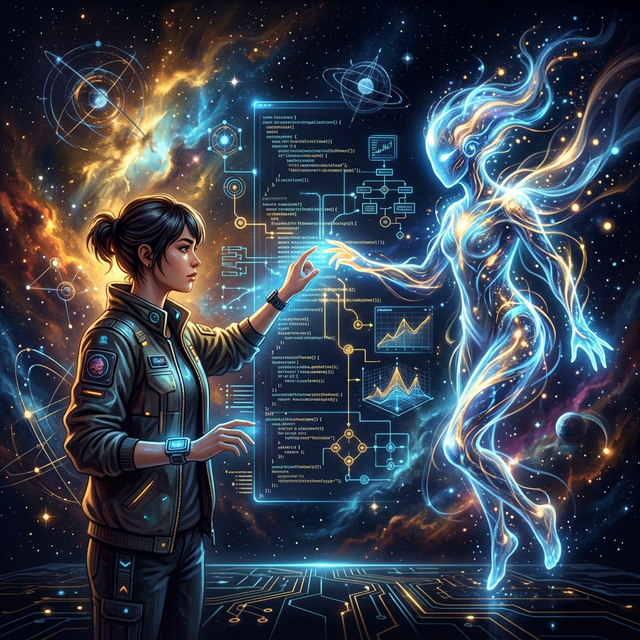
The solo "10x engineer" is largely a myth. Real software development depends on tightly integrated teams. But as organizations introduce LLMs and autonomous coding assistants, a dangerous fragmentation is occurring: AI agents are operating in silos away from the human engineers. The future of software development requires Human-AI Symbiosis.
The Challenge of Fragmented Agentic Tooling
Most development teams today use a mishmash of AI tools—Copilot in the IDE, a ChatGPT window for debugging, and automated scripts in the CI pipeline. This creates a fragmented context. When an AI agent generates a complex database migration, the rest of the human development team often lacks the context of why the agent made those architectural choices. This leads to massive technical debt and the "Ghost Bug Epidemic."
Synchronizing the Swarm
To achieve High Velocity Engineering, teams must adopt platforms that enforce deep collaboration between human architects and specialized AI swarms. FastBuilder.AI solves this through a unified architectural layer.
- The Core: Visual Golden Topology Mesh (VGTM): Instead of humans trying to read thousands of lines of AI syntax, both the human team and the AI agents collaborate entirely on a graphical Topology Mesh. Humans define the nodes and secure boundaries, and the AI agents populate the explicit logic connecting them.
- Context Sharing via MCP: The Model Context Protocol allows standardized context sharing. Whether an AI is writing an iOS frontend or a Rust backend, it shares the exact same contextual understanding of the project's state, directly aligning with the Jira or Trello tickets managed by the human Product Managers.
- Asynchronous Agent Handoffs: A human developer can write the unit test spec, hand it to a 'Test-Gen Agent', which then passes the requirements to an 'Implementation Agent'. The human reviews the final PR, drastically multiplying individual output without losing oversight.
Visual Collaboration in 5D XR
FastBuilder takes teaming further by enabling Spatial Architecture. Distributed engineering teams can log into a virtual 5D representation of their entire codebase. They can physically walk through the logic flows alongside their AI agents, visually spotting bottlenecks and memory leaks as glowing red nodes on the mesh before the code is ever merged into `main`.
Conclusion
The highest performing engineering teams of the 2030s will not be those who replace their developers with AI, but those who perfectly sync their developers *with* AI swarms via a centralized, deterministic platform.