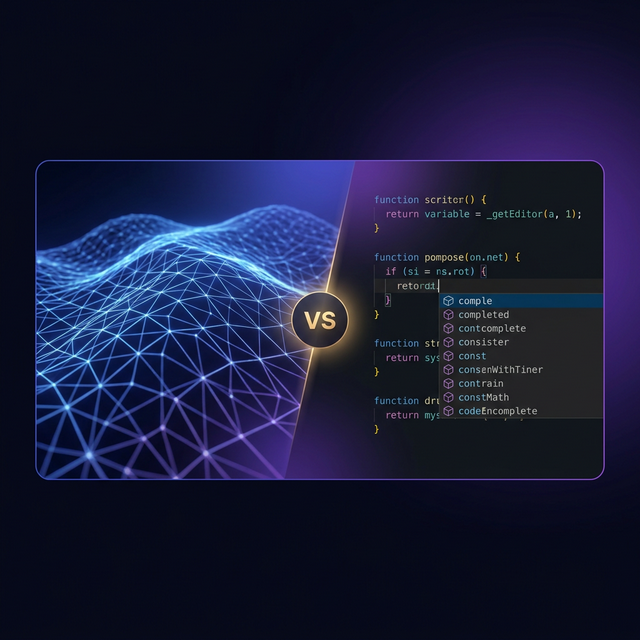
The AI code generation market has exploded. Tools like GitHub Copilot, Cursor, Devin, and countless others promise to make developers faster. But is speed the right metric? Let's compare the landscape of generative AI tools with the architectural approach of FastBuilder.AI.
Category 1: Autocomplete & Inline Assistants
Examples: GitHub Copilot, Tabnine, Amazon Q
These tools are fundamentally glorified autocomplete. They live inside the developer's traditional IDE and analyze the immediate surrounding code to predict the next few lines. They are fantastic for generating boilerplate syntax or writing simple regex functions. However, they lack broad architectural awareness. They cannot architect a new microservice or understand the deep topological relationships of a large monorepo.
Category 2: Autonomous "Dev" Agents
Examples: Devin, Codeium Command
These tools represent the next step: autonomous agents that operate in the terminal, read documentation, and execute loops to solve complex Github issues. They are powerful, but they operate predominantly via "Vibe Coding"—they continuously output probabilistic code guesses until tests pass. This probabilistic nature is a severe liability for enterprise applications where security, compliance, and strict structural integrity are non-negotiable.
Category 3: Deterministic Architecture Platforms
Example: FastBuilder.AI
FastBuilder is arguably in a different category entirely. Rather than generating text-based code based on a prompt and hoping it works, FastBuilder enforces a Visual Golden Topology Mesh (VGTM).
- Architectural First: The human developer defines the strict mathematical topology of the application (e.g., this authentication node must precede this database read node). The AI agent is then constrained to only generate code that fulfills those deterministic boundaries.
- Swarm Coordination: Instead of a single generic model writing everything, FastBuilder leverages the Model Context Protocol (MCP) to orchestrate highly specialized agents—one model optimized for React layouts, another fine-tuned explicitly for high-performance Rust concurrency—all collaborating on the same mesh.
- Zero "Breaks Off" Failures: Because the AI cannot violate the golden topology, enterprise teams can achieve extreme High Velocity Engineering without the risk of an LLM hallucinating a critical security flaw deep in the business logic.
The Verdict
If you need to write a quick Python script, Copilot is perfect. If you want an agent to prototype a weekend project, Devin is incredible. But if you need to build secure, scalable, compliant enterprise software without accumulating massive technical debt, you need the deterministic constraints of FastBuilder.AI.