The CTO Command Center: Mastering the Architecture Recovery Protocol with FastBuilder.AI
The role of the modern Chief Technology Officer (CTO) and Fractional CTO partners has never been more taxing or complex. Once visionary leaders responsible for charting paths toward innovation and strategic growth, today’s engineering leaders often find themselves bogged down by a relentless tide of structural decay. It's the silent killer of modern software companies: the accumulation of technical debt, architectural drift, sprawling microservices with obscured dependencies, and the dreaded "orphan components" that no longer have clear ownership yet remain critical to operations.
When an organization scales, engineering cycles inevitably degrade. Instead of spending 80% of their time innovating and 20% keeping the lights on, engineering teams find themselves using 80% of their time just to maintain legacy setups.
To survive and truly thrive, Fractional CTOs and technical executives require more than just another dashboard or project management tool. They require a systemic intervention—a comprehensive framework to diagnose, pivot, govern, and autonomously execute changes at massive scale.
Enter the FastBuilder.AI CTO Command Center, also known as the "CTO in a Box."
This strategic suite and board reporting toolkit provides engineering leaders with unprecedented capabilities to reverse structural rot, establish ironclad governance, and deploy an autonomous "Agent Fleet" force multiplier. Based on the FastBuilder.AI Architecture Recovery Protocol, the Command Center empowers CTO Partners across four actionable pillars: Diagnostic Visibility, Strategic Pivot, Technical Governance, and Autonomous Execution.

Pillar 1: Diagnostic Visibility – Auditing Structural Rot via Digital Twin
Before you can fix an architecture, you must understand its current state—not as it was designed three years ago in a static document, but as it behaves right now in production. The first pillar of the CTO Command Center enables leaders to audit structural rot via a Digital Twin of their enterprise architecture.
When legacy systems grow organically without strict oversight, the result is architectural spaghetti. Components become entangled; bounded contexts bleed into one another; and orphaned services actively consume resources while exposing security vulnerabilities.
Through the CTO toolkit, Fractional CTOs gain immediate, indisputable diagnostics:
- CBFDAE Asset Inventory: A granular, real-time mapping of all operational assets (Component, Block, Function, Data, Access, Event).
- Topology & Orphan Ratio Report: Highlights disconnected or heavily underutilized components, instantly pinpointing targets for decommissioning and cost reduction.
- C0-C3 VR Architecture Walkthrough: Leveraging UpperSpace's spatial visualization, CTOs can step directly into a 3D topological map of their architecture, allowing both technical stakeholders and the board to visually comprehend the system’s health.
The Actionable Plan: The system runs advanced Louvain Clustering algorithms against your codebase. This identifies the true cohesion and coupling of your components, recommending natural boundaries for microservice extraction and structural refactoring.
Pillar 2: Strategic Pivot – Designing the Architecture Delta
Once visibility is established and the rot is quantified, the CTO initiates the Strategic Pivot. This is where the leader designs the "Architecture Delta"—the mathematically calculated gap between your current entangled state and your desired pristine target state.
"Big bang" rewrites notoriously fail. Incremental refactors often lose momentum. The CTO Command Center provides the tools necessary to systematically plan this transition:
- Connectivity Matrix (F-F vs E-E): A detailed mapping of Frontend-to-Frontend and Edge-to-Edge networking dependencies, allowing architects to define exactly how services will interact in the target state.
- System-Level specs.md Blueprint: The definitive, single-source-of-truth declarative documentation defining the new architectural patterns.
- FGMC Expansion Roadmap: The FastBuilder Generic Meta-Component roadmap defines the phases, objectives, and deliverables required to scale the new architecture iteratively.
The Actionable Plan: Through the CTO dashboard, teams generate an "FGMC Delta." This crucial step plans out exactly 50% of the required architectural work before execution even begins, ensuring perfect alignment between strategy and execution and charting a determinable, risk-mitigated path to completion.
Pillar 3: Technical Governance – Embedding "Rules of the House"
A successful architectural pivot is worthless if the system immediately begins to drift back into chaos. Technical Governance is the immune system of your software architecture. It embeds the "Rules of the House" directly into your developer workflows and deployment pipelines.
The Command Center enforces governance not through lengthy, ignored PDF manuals, but through strict automated guardrails:
- Standardized
upperspace.yml: From development to production, every service instantiation must conform to predefined, declarative scaling policies. - True Component Signature Guide: Establishes a rigorous definition of what a component must look like (identity, lifecycle, connections). If a new service does not match its required signature, it is flagged and blocked from deploying.
- Certified Enterprise Skills DB: A matrix mapping engineering talent and proficiencies to the domains they are modifying.
The Actionable Plan: Governance is maintained autonomously via the NodeRegistry. This centralized directory enforces the accepted architectural hierarchy, instantly preventing "Architecture Drift" the moment a developer attempts to commit an unauthorized dependency.
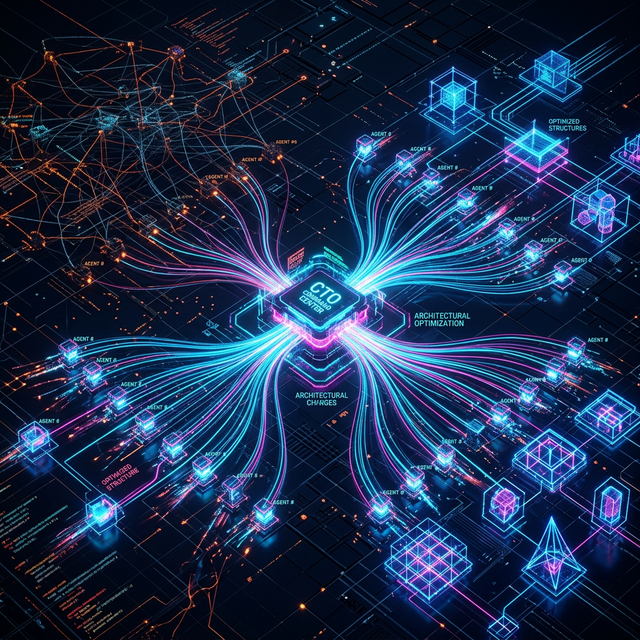
Pillar 4: Autonomous Execution – A Force Multiplier via Agent Fleet
Strategy and governance mean nothing without the ability to execute. This brings us to the most transformative pillar of the CTO Command Center: Autonomous Execution. FastBuilder.AI shifts the paradigm from human-bounded engineering limits to machine-speed execution through a fleet of AI-driven agents.
This is not a simple copilot autocompleting lines of code; it is a specialized workforce capable of ingesting your FGMC Delta, adhering to your Technical Governance rules, and safely executing massive swaths of rote engineering tasks.
The dashboard provides Fractional CTOs total oversight of this AI workforce:
- Agent Fleet IP & Heartbeat Log: Live telemetry of your autonomous agents ensuring healthy securely allocated task processing.
- Session Bridge Interaction Map: A visual node map showing instantaneous connections between frontend clients, gateways, and backends.
- CGS Task Completion Summary: Tracks exactly how many architectural migrations, testing suites, and component standardizations have been completed by the agent fleet.
The Actionable Plan: The CTO deploys CGS (Code Generation System) Agents to execute the previously designed FGMC delta autonomously. By delegating the heavy lifting of structural refactoring to the Agent Fleet, your human engineers are freed from technical debt servitude.
The Board Dashboard: Translating Engineering into ROI
A critical part of a Fractional CTO's job is translating deep technical strategy into business outcomes for the board of directors. The FastBuilder.AI CTO Command Center includes a zero-translation Board Dashboard designed to present engineering victories as undeniable business ROI.
When the Architecture Recovery Protocol is executed via the Toolkit, the metrics speak for themselves:
- 4.5x Efficiency Gain: By automating refactoring and enforcing governance, overall engineering output drastically multiplies.
- $420k Technical Debt Paid: Calculated immediately based on decommissioned legacy services and human-hours saved.
- 100% Compliance: With NodeRegistry acting as an automated bouncer, security protocols and architectural compliance reach perfection.
- 6 Days Time-to-Market: The velocity of feature delivery accelerates as the drag of legacy spaghetti code is eliminated.
But the most staggering metric lies in the Engineering Allocation Pivot. Before FastBuilder.AI, the average enterprise software team is trapped in an 80/20 nightmare (80% maintenance / 20% innovation). By leveraging the Diagnostic, Pivot, Governance, and Execution loop of the CTO Command Center, that ratio is radically inverted. Engineering teams suddenly enjoy 85% Innovation Time while maintenance overhead drops to an automated 15%.
The FastBuilder.AI CTO Command Center hands control back to technical leadership. CTO Partners can now pivot from managers of decay to true architects of innovation, backed by a platform that delivers the hard, measurable ROI of architectural excellence.