The Anti-pattern Skills Registry: Teaching AI What To Do When Code Looks Wrong
In the rapidly evolving landscape of artificial intelligence and automated code generation, the industry has largely fixated on a singular, idealized objective: teaching AI models the "Golden Path." Vast datasets are compiled, containing millions of pristine repositories reflecting perfect architectures, optimized algorithms, and elegant design patterns. We train our Large Language Models (LLMs) to recognize excellence, assuming that by exposing them exclusively to "good" code, they will naturally reproduce it.
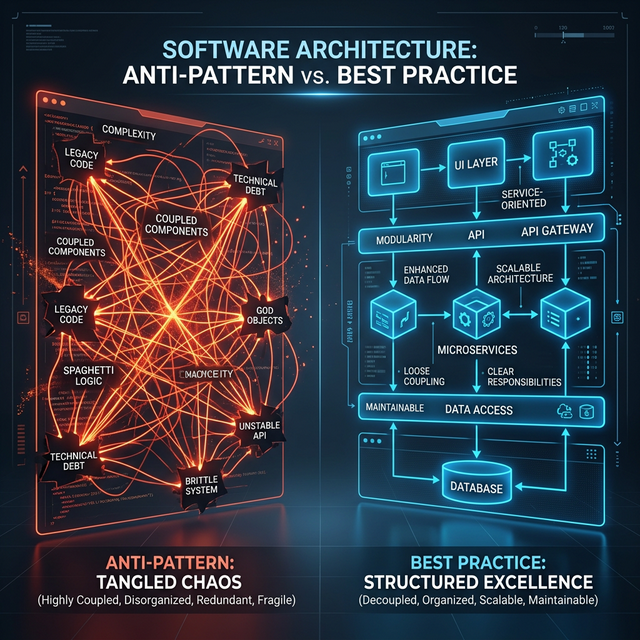
Yet, any seasoned software engineer knows that the reality of enterprise coding is rarely a golden path. It is a labyrinth of technical debt, legacy decisions, tightly coupled modules, and well-intentioned compromises.
When an AI—trained solely on ideal scenarios—encounters the messy, chaotic reality of an older, evolving codebase, a critical failure occurs. It attempts to apply pristine, abstract solutions to uniquely tangled problems. Because it only knows "the right way" to build from scratch, it lacks the operational playbook for how to behave when the existing structure is fundamentally flawed.
This is the exact problem we are solving at FastBuilder.AI. We realized that true architectural intelligence requires more than just knowing what a perfect system looks like. It requires a profound, deterministic understanding of how to safely navigate, interact with, and refactor a deeply imperfect system.
It requires an Anti-pattern Skills Registry.
The Blind Spot of Generative AI Coding
Generative AI is fundamentally probabilistic. It predicts the next sequence of tokens based on statistical likelihood derived from its training data. Because its generic training data heavily favors popular, well-documented frameworks and standard implementation patterns, the AI assumes a baseline level of structural sanity in the codebase it is modifying.
When you ask a standard coding assistant to "Add a new payment method to the checkout flow," it envisions a modern, decoupled architecture. It assumes there is a clearly defined PaymentGateway interface, an independent UIComponent, and a robust dependency injection system.
But what if your checkout flow is a 5,000-line legacy monolith where UI rendering, business logic, and raw SQL queries are all intertwined in the same file? The generic AI will attempt to blindly inject its idealized interface into the monolith. It won't understand the brittle nature of the surrounding code. It might inadvertently severe a hidden dependency or introduce a race condition because it couldn't "see" the spaghetti logic radiating outward from the injection point.
The AI assumes the architecture is clean. It lacks the "common sense" operational playbook for what to do when it realizes it is operating within an anti-pattern.
It's Not Just About "What Not To Do"
A common misconception is that anti-patterns are simply a list of things an AI should avoid generating. While it's true we don't want AI writing new spaghetti code, the true value of the Anti-pattern Skills Registry is defining the AI's reaction to existing chaos.
The Registry answers the critical engineering question: "I have found a God Object that cannot be easily dismantled right now. How do I safely add a feature to it without making it worse or breaking the entire system?"
Instead of solely relying on probabilistic inference, we provide the AI (like our proprietary Mantr RLM system) with a deterministic, rule-based topological playbook. The Registry maps code constructs into highly specific topological descriptors:
- Vertices (V): The atomic elements of logic (functions, classes, database tables).
- Edges (E): The explicit and implicit connections between these elements.
- Manifolds (M): The broader conceptual surfaces or clusters of related logic.
- Fields (F): The data properties propagating across the manifolds.
- Boundaries (B): The intended interfaces and limits of the modules.
When an AI analyzes a codebase, the Anti-pattern Skills Registry evaluates the observed topology against a massive database of known anti-patterns and, crucially, provides the mitigation strategy.
Strategy 1: Safely Navigating the God Object Topology
If the AI detects a single Vertex (a class) with an exponentially higher degree of outgoing Edges (dependencies) than any other Vertex in the Manifold, it identifies a God Object.
Instead of trying to inject a clean, modern interface directly into the God Object (which would likely fail or cause massive regressions), the Anti-pattern Skill dictates a specific reaction:
- Quarantine the Addition: Do not add new internal state variables to the God Object.
- Facade Injection: Create a fresh, decoupled service external to the God Object.
- Bridge the Gap: Only write a minimal, pass-through method inside the God Object that immediately delegates execution to the clean external service.
The AI learns how to work with the anti-pattern without contributing to it.
Strategy 2: Wiring Spaghetti Logic Defensively
Spaghetti logic is topologically represented by a lack of coherent Manifolds. The Edges between Vertices cross Boundaries arbitrarily.
When the Anti-pattern Skills Registry detects these cyclic dependencies and chaotic edge mappings, the AI knows that any structural modification is extremely high risk. The skill explicitly instructs the AI to shift its methodology from "Standard Implementation" to "Defensive Architecture."
It knows it must implement extensive logging around its injection points, wrap modifications in tight try/catch error-handling nets, and rigorously avoid creating new edges across disparate manifolds unless explicitly authorized by a human engineer.

The Structural Mechanics of the Mitigation Playbook
At its core, the Anti-pattern Skills Registry is a massive database of deterministic YAML definitions. These YAML files act as the translation layer between human architectural intuition and machine parsing capabilities.
Every anti-pattern skill features three core components:
- The Detection Signature: Regular expressions, abstract syntax tree (AST) node structures, and Louvain clustering algorithms that uniquely identify the bad practice.
- The Damage Assessment: A topological calculation of how brittle the surrounding code is based on connection density.
- The Executive Playbook: The exact step-by-step instructions the agent must follow to safely implement the user's prompt given the current hostile environment.
For instance, a CircularDependency anti-pattern skill for TypeScript doesn't just block the AI from moving files. It provides the solution playbook: "Extract the shared types/interfaces into an independent 'core' directory. Update the imports in File A and File B to point to the new core directory, severing the cyclic edge."
Elevating AI to Senior Architectural Status
A junior developer looks at a messy codebase, panics, and blindly starts hacking away at a ticket, oblivious to the structural damage they are causing.
A senior engineer takes a step back. They map the dependencies. They recognize the technical debt. They identify the anti-patterns, and they formulate a specific strategy to implement the requested feature without collapsing the fragile house of cards. They know exactly how to behave when the code looks wrong.
By equipping our agents with the Anti-pattern Skills Registry, we are instilling them with this precise senior-level architectural intuition. They don't just write code; they analyze the environment, recognize the dangers, and apply the correct mitigation strategy to safely navigate the chaos.
Teaching an AI what clean architecture looks like is easy. Teaching it how to survive, adapt, and selectively refactor its way out of a decade's worth of technical debt—that is the true frontier of autonomous software engineering. And that is exactly what the Anti-pattern Skills Registry delivers.