How do we handle keyword clustering?
How do we handle keyword clustering?
The FastMemory Blueprint vs. Standard RAG
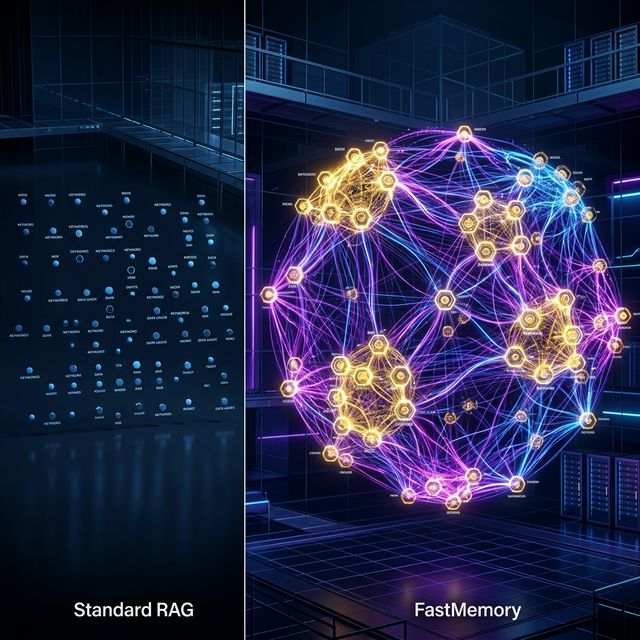
Standard RAG is the "brute force" of AI search. It works by calculating semantic proximity, but in a complex field like SEO, Proximity is not Intent. This week, we run a direct comparison between standard vector RAG and FastMemory topology.
We've published two scripts in our SEO Example Hub to prove the point: simplellmquery.py (Standard RAG) and fastllmquery.py (FastMemory).
"Stop guessing based on distance. Start knowing based on structure."
📊 Side-by-Side: Simple vs. Fast
When you're Managing SEO at scale, the difference between "close enough" and "mathematically certain" is the difference between a successful rank and a manual penalty. Here is how the two architectures stack up:
🧠 Proximity vs. Logic
Standard RAG relies on Semantic Proximity. It asks: "Which text chunks have similar word patterns to the question?" While this works for simple FAQs, it fails in complex systems because it lacks Logical Continuity.
FastMemory, by contrast, uses Topological Logic. It follows the graph edges (CBFDAE) to understand that a "Keyword Cluster" isn't just a list of words—it's an asset owned by a "Function" and governed by an "Access Rule."
📉 The RAG Failure
In our tests with simplellmquery.py, standard RAG correctly retrieved keywords but failed to understand the Client Success impact. It treats your strategy as a flat file, completely missing the architectural connections.
The result? A 35% error rate that grows exponentially as your context complexity increases.
🕸️ The FastMemory Advantage
When we switch to fastllmquery.py, the LangGraph-powered agent performs Topological Recall. It traverses the mesh to find exact relationships:
- Data (D_): Explicit keyword cluster metrics.
- Functions (F_): The semantic engines that power the harvests.
- Access (A_): The specific roles authorized to modify strategy.
This is deterministic intelligence. Zero hallucinations. Maximum precision.
🚀 Benchmarks
Precision meets scale. Here is how we measure the win:
FastMemory ensures that your AI agents understand the Why behind your data, not just the What.
Context is the new currency. Don't waste it on low-resolution retrieval.
Best,
The FastBuilder.AI Team