The Future of Software Engineering: 10 Predictions for 2030
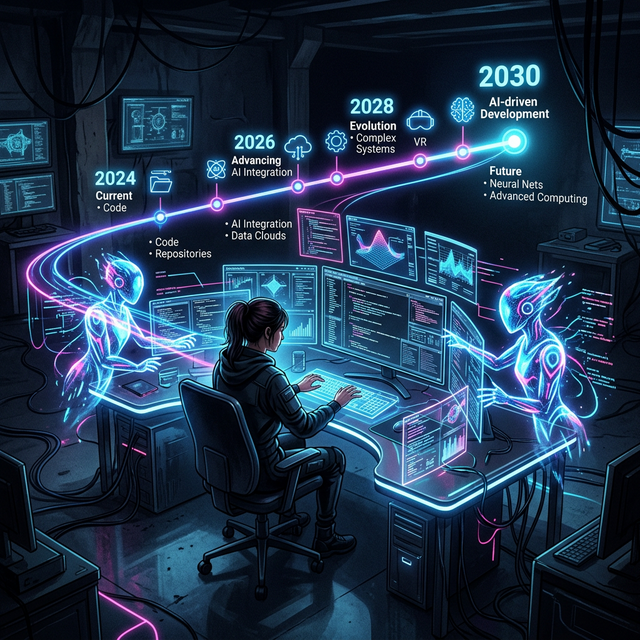
Software engineering is undergoing its most dramatic transformation since the invention of high-level programming languages. By 2030, the way we build, ship, and maintain software will be fundamentally different. Here are 10 evidence-based predictions grounded in current technology trajectories.
1. Code Will Be Verified, Not Just Tested
Testing proves the absence of found bugs. Verification proves the presence of correctness. By 2030, formal verification of AI-generated code against topological models will be standard practice, not a research curiosity.
2. The 10x Engineer Will Be an Architect
The most productive engineers won't write the most code — they'll design the best constraints. Defining the Golden Mesh topology, setting access boundaries, and designing event flows will be more valuable than writing business logic.
3. AI Hallucination Will Be a Solved Problem
Topological verification eliminates hallucinations by providing a mathematical constraint surface. By 2030, shipping unverified AI-generated code will be seen as negligent — like shipping untested code was in the 2000s.
4. No-Code and Low-Code Will Merge with Pro-Code
The boundary between no-code tools and professional development environments will dissolve. Every platform will generate code; the differentiator will be whether that code is verified against an architecture.
5. Technical Debt Will Be Computable
Code topology makes technical debt measurable. The distance between your current codebase topology and the ideal topology becomes a quantifiable metric that boards can track alongside revenue and churn.
6. Security by Topology
Security vulnerabilities will be detected topologically — by identifying unauthorized data flows, misconfigured access boundaries, and anomalous event patterns — before code is deployed.
7. Real-Time Architecture Governance
Static architecture reviews will be replaced by real-time topological monitoring. Any code change that violates architectural constraints will be automatically blocked, regardless of whether it comes from a human or AI.
8. Programming Languages Will Matter Less
When AI generates code against a language-agnostic topology, the implementation language becomes a deployment decision rather than a development decision. Teams will switch languages as easily as switching CSS frameworks.
9. Continuous Architecture Delivery
Just as CI/CD automated code deployment, Continuous Architecture Delivery (CAD) will automate architectural evolution. The Golden Mesh will be continuously updated, and AI agents will continuously optimize the codebase to match the ideal topology.
10. The Rise of the Software Topologist
A new role will emerge: the Software Topologist — an engineer who specializes in designing, analyzing, and optimizing the topological structure of large-scale software systems. This role will command premium compensation and be essential for enterprise AI adoption.
Conclusion
The companies that adopt topological verification earliest will build compounding advantages. Their codebases will be cleaner, their AI-generated code will be more reliable, and their engineering teams will ship faster. The future is not just AI-generated code — it's AI-verified code.