Escaping the Flat Earth: Migrating Standard RAG to FastMemory
Transform your disconnected vector store into a high-fidelity, deterministic graph system in minutes.
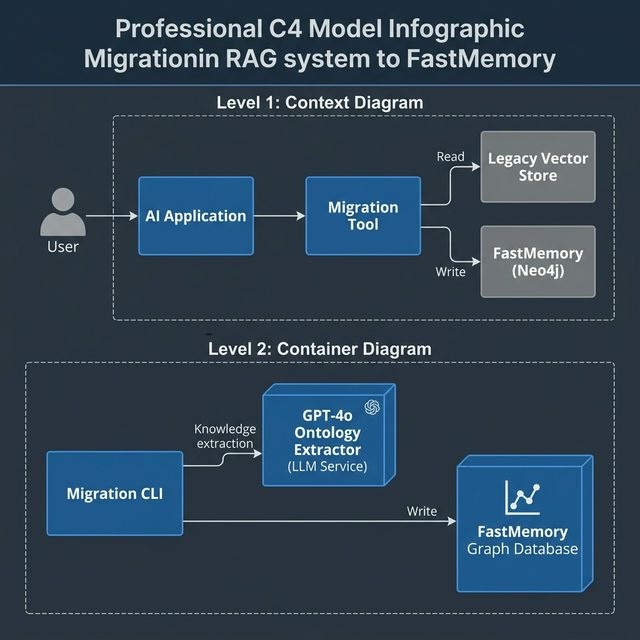
Standard RAG systems are hitting a wall. As institutional knowledge grows, the "Flat Earth" model of storing disconnected text chunks leads to hallucinations, duplicate context, and massive sync latencies.
The solution isn't "better chunking"—it's a Topological Shift. By migrating to FastMemory, you move from probabilistic retrieval to deterministic reasoning. And we've just made that transition automated.
The Migration Architecture (C4 Model)
Our migration framework follows the C1/C2 C4 model standards to ensure clarity in enterprise deployment:
- L1: System Context – The User interacts with the AI Application, which now utilizes a dedicated
Migration Toolto bridge the gap between legacy Vector Stores and the newFastMemory (Neo4j)graph database. - L2: Container Diagram – Inside the tool, we deploy a
Migration CLIthat orchestrates anOntology Extractor(powered by GPT-4o) to distill raw strings into structured CBFDAE nodes.
Step 1: Automated Ontology Extraction
We’ve released a new script, extract_ontology.py, which uses a high-fidelity prompt to scan your existing RAG chunks and extract the "DNA" of your system.
# Example CBFDAE Extraction Logic
extractor = OntologyExtractor()
result = extractor.extract_from_text(raw_rag_chunk)

# Result: JSON-ready graph nodes and relationships
# F_Harvest_Keywords -> PRODUCES -> D_Keyword_CSV
The Prompt Blueprint: Distilling Intent
The transition from a flat vector to a graph isn't just a format change—it’s a move from semantic similarity to structural intent. Our extraction prompt uses a "System-First" logic to scan your text:
Extraction Logic Flow:
- Batched Scanning: We iterate through your vector store chunks (or legacy schema documents).
- Identity Tagging: The LLM identifies nouns and assigns them the **CBFDAE prefixes** (e.g., if it's a role, it's
A_Admin; if it's a file, it'sD_Report). - Relationship Inference: The prompt forces the LLM to find the "Verb Edges"—how do these chunks interact? (e.g., "Function X generates Data Y").
- Topological Normalization: The resulting JSON is harmonized with your global graph instance.
Whether you are starting with a **Pinecone vector store** or a **legacy Excel ontology**, the prompt serves as the translation layer that converts static text into active, traversable memory.
Step 2: Building the "Golden Mesh"
Once the ontology is extracted into JSON, the rag-migration tool orchestrates the transformation into a persistent Neo4j graph. Unlike a vector store, where each chunk is isolated, FastMemory builds a relational mesh that enforces system logic.
1. Semantic Harmonization via MERGE
The core power of the migration script lies in its use of the Cypher MERGE command. This ensures that if multiple standard RAG chunks reference the same C_Marketing component, they are harmonized into a single "Source of Truth" node. This eliminates the duplicate context that often confuses LLMs in standard RAG.
2. Relational Edges (The Logic Layer)
The extractor doesn't just find names; it identifies directional intent. The migration script automatically builds the following core relationships:
(f:Function)-[:PRODUCES]->(d:Data): Maps the output of an action to its resulting data.(c:Component)-[:CONTAINS]->(b:Block): Establishes the structural hierarchy.(a:Access)-[:GOVERNS]->(f:Function): Enforces security and permission boundaries.(f:Function)-[:TRIGGERS]->(e:Event): Tracks the causal side-effects of operations.
3. Enabling Topological Traversal
The result is a "Golden Mesh" that an AI agent can traverse with 100% accuracy. Instead of searching for "how to harvest keywords," a FastMemory agent performs a 1-hop traversal: MATCH (b:Block)-[:EXECUTES]->(f:Function {label: 'Harvest'}). It finds the answer not through statistical similarity, but through **verified system topology**.
Why Migrate?
- Determinism: 0% hallucinations on structural system queries.
- Speed: 30x faster sync via surgical delta updates.
- Auditability: Every AI decision is traceable through the graph edges.
© 2026 FastBuilder.AI. All rights reserved.