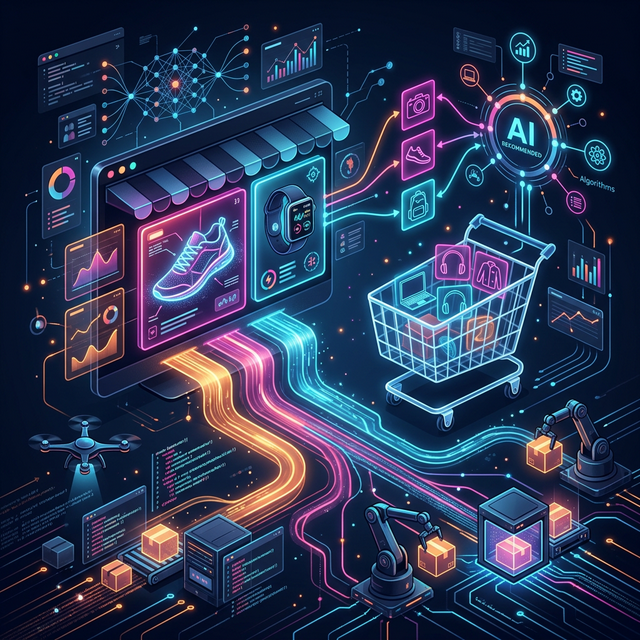
The retail and e-commerce industries are defined by wafer-thin margins and brutal competition. While the previous decade was about moving infrastructure to the cloud or experimenting with blockchain tracking, the current decade is entirely defined by Agentic AI and High Velocity Engineering.
The Legacy E-Commerce Bottleneck
Modern e-commerce platforms (like Shopify or Magento) are powerful, but highly constrained by their plugin ecosystems. When a retailer needs a custom loyalty points system integrated with their specific warehouse ERP and a third-party CRM, the development cycle traditionally involves months of custom integration work, heavy QA, and brittle API connections. If an endpoint changes, the entire checkout flow can break.
How Agentic AI Injects Extreme Efficiency
1. Dynamic Edge-Case Handling
Traditional checkout logic is a spiderweb of `if/else` statements handling split shipments, localized tax codes, and diverse promotional rules. Agentic AI can be securely sandboxed via the Model Context Protocol (MCP) to evaluate these complex, unstructured edge cases dynamically at runtime, reducing the need for thousands of lines of fragile conditional code.
2. Automated Micro-Service Generation
Using platforms like FastBuilder.AI, retail architects can define a new business requirement—for example, a real-time inventory synchronizer for pop-up shops—and the AI will generate the entire microservice, complete with the optimal Code Topology (VGTM), secure API gateways, and automated tests. This shrinks a 6-week sprint into a 6-hour verification task.
3. The Death of "Vibe Coding" in Production
In retail, a bug in the shopping cart costs thousands of dollars per minute. Allowing an LLM to blindly generate checkout code ("Vibe Coding") without structural constraints is catastrophic. FastBuilder prevents this by utilizing a deterministic engine. The AI operates within a strict topology framework, ensuring that any generated code mathematically fits the existing payment architecture before it is ever compiled.
Personalized, Generative Storefronts
Beyond the backend, Agentic AI is revolutionizing the frontend. Instead of static product grids, AI agents can generate personalized, React-based UI components on the fly for specific users based on their browsing history, weaving in generative product descriptions and context-aware styling instantaneously.
Conclusion
For retail and e-commerce platforms, Agentic AI isn't just about writing code faster; it's about fundamentally changing the architecture of digital storefronts. By enforcing deterministic constraints, platforms like FastBuilder ensure that retailers can achieve High Velocity Engineering without sacrificing the bulletproof stability required for global commerce.